A CFD margin calculator estimates the money required to open a position. A leverage calculator expresses the relationship between that deposit and the exposure it supports. Used together, they help answer two different questions: can the account support this trade, and how much market exposure would the trade create?
Neither calculator tells you the maximum loss or whether a position is sensible. The useful output is not simply “margin required.” It is margin required alongside potential loss, remaining account equity and the effect on existing positions.
Before applying any figures, check the product’s availability, the provider’s legal entity and your client classification. US readers should not treat an overseas CFD calculator as evidence that its products are available to their accounts. Use the CFTC’s registration and background checks when checking derivatives firms, and confirm product eligibility separately.
What a CFD Margin Calculator Should Calculate
A basic calculator combines position size, price and margin rate to estimate the opening deposit. A more useful version also handles contract multipliers, currency conversion, existing positions and different margin rates across exposure bands.
The distinction matters because “two contracts” says little without knowing what each contract represents. Two share CFDs might represent two shares. Two index CFDs might represent a stated cash value for every index point. Entering the wrong multiplier can produce a neat answer that is completely wrong.
Within a broader CFD trading software setup, the calculator should act as a check before submitting an order. It should make its assumptions visible rather than hide them behind a green approval message.
Keep three figures separate: the position’s notional value, the required margin and the account’s equity. They measure exposure, collateral and available account value respectively.
The Core Margin and Leverage Formulas
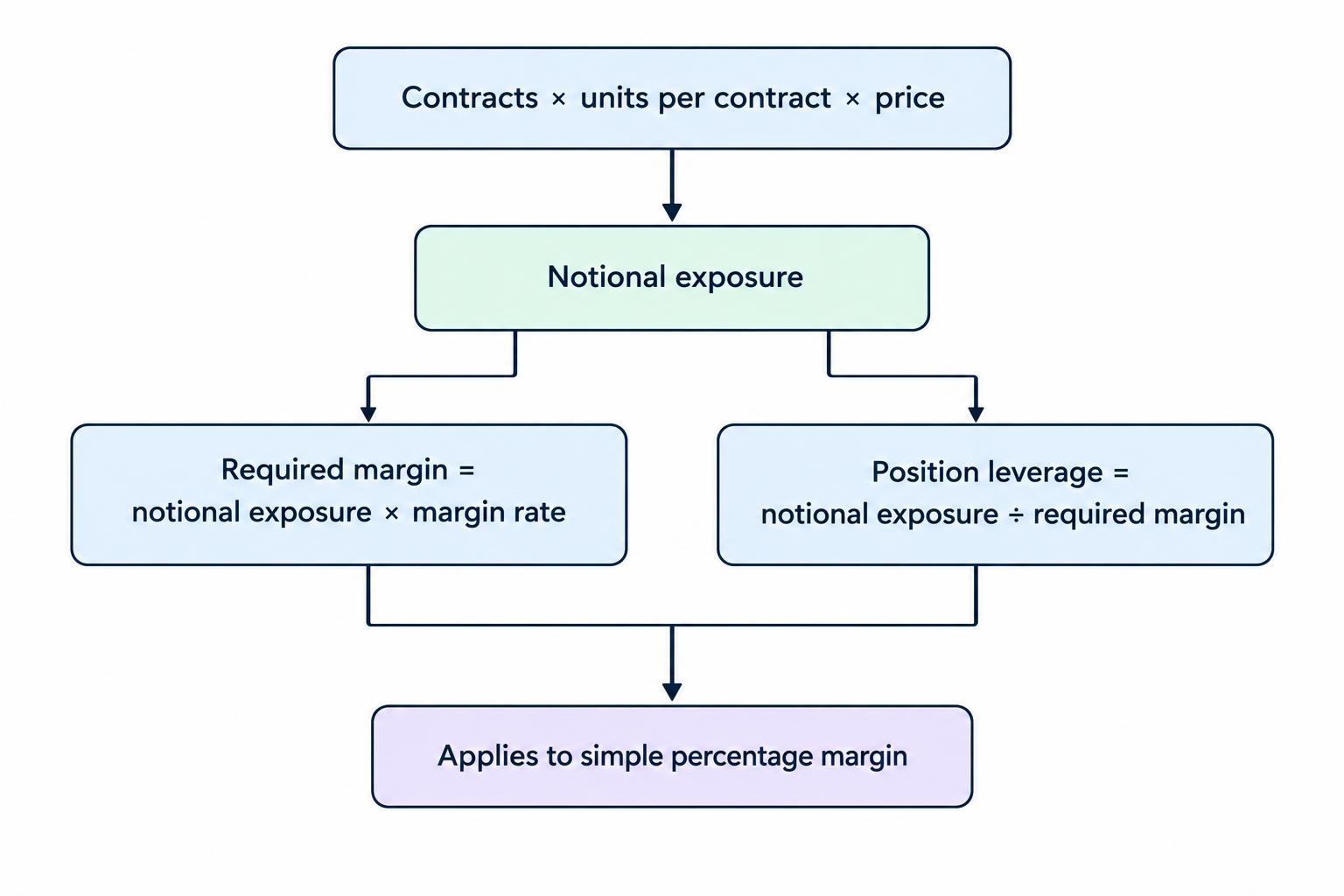
For a straightforward linear CFD, calculate notional exposure before calculating margin:
Notional exposure = number of contracts × units per contract × price
Required margin = notional exposure × margin rate
Position leverage against required margin = notional exposure ÷ required margin
Where one flat margin rate applies, leverage is the reciprocal of that rate. A 5% requirement corresponds to 20:1; a 20% requirement corresponds to 5:1. Enter 5% as 0.05 when multiplying, not as 5.
For an index CFD, use the contract’s cash value per point as the multiplier. For currency CFDs, check whether size is expressed in lots or units of the base currency. Do not force every instrument into a calculator designed for shares.
These formulas describe simple percentage margin. Tiered requirements, fixed amounts per contract and other contract terms need their own calculation rules.
Worked Example: A Share CFD
Assume a hypothetical share CFD represents one share, its opening price is $50 and the proposed position contains 200 contracts. The margin rate is 20%.
The notional exposure is 200 × $50 = $10,000. Required margin is $10,000 × 0.20 = $2,000, giving leverage of 5:1 against the required deposit.
A 1% adverse price movement creates a $100 trading loss before costs. That equals 5% of the opening margin, not 1%. The price movement applies to the $10,000 exposure; the smaller deposit does not shrink the position’s profit or loss.
Worked Example: An Index CFD With Currency Conversion
Assume an index stands at 6,000 points and each contract is worth $1 per point. Two contracts create exposure of 2 × $1 × 6,000 = $12,000. At 5% margin, the requirement is $600.
If the account uses pounds and the hypothetical conversion rate is £0.80 per dollar, that becomes £480. A calculator using GBP/USD at $1.25 per pound would instead divide $600 by 1.25.
The conversion direction deserves attention. Multiplying by a rate that should be divided can distort the result without producing an obvious error message.
Use the Margin Rate for Your Account
A calculator’s default rate is not necessarily your rate. Match the instrument, provider entity and retail or professional classification before relying on the result. Where a provider requires more margin than a regulatory minimum, use the provider’s applicable requirement.
For context, the following minimum percentages apply to these categories under the FCA’s retail CFD margin requirements in COBS 22.5. They are UK rules, not a universal schedule.
| Underlying asset category | Minimum margin | Corresponding leverage |
|---|---|---|
| Major currency pairs | 3.33% | Approximately 30:1 |
| Major stock indices, minor currency pairs and gold | 5% | 20:1 |
| Minor stock indices and commodities other than gold | 10% | 10:1 |
| Individual shares | 20% | 5:1 |
The 3.33% regulatory figure is rounded. An exact 30:1 calculation uses 1 ÷ 30, or 3.3333…%. Retain the precision used by the platform and round the final cash requirement using its stated method.
Do not select a higher leverage setting simply because an independent calculator offers it. An available input is not proof that the setting applies to your account.
Margin Is Not the Amount You Plan to Risk
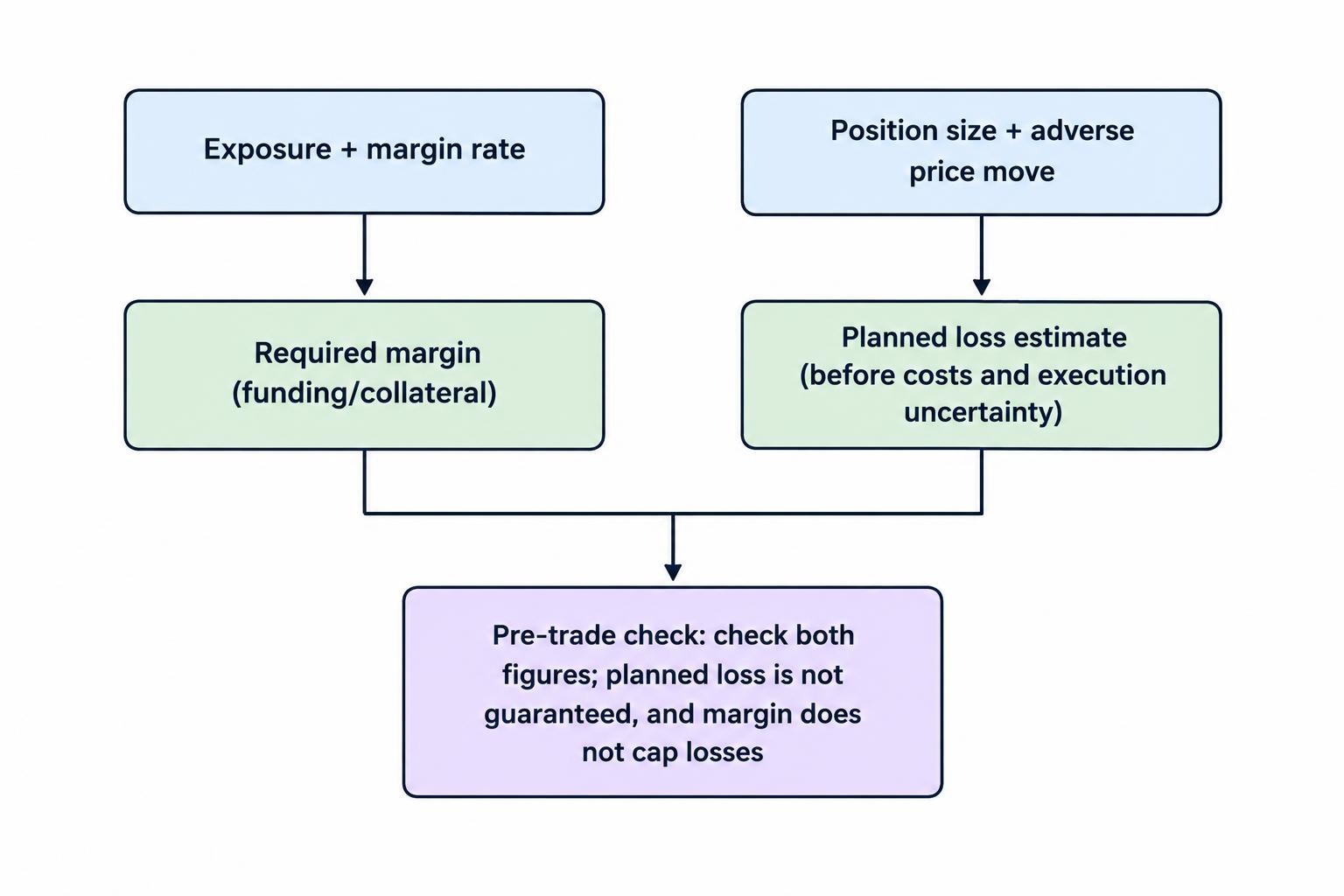
Margin answers a funding question. Position sizing answers a loss question. Start with the loss scenario, then check whether the resulting position fits the account’s margin requirements.
Suppose a hypothetical long share CFD has an entry price of $50 and a planned stop at $48. With one share represented by each contract, the intended price risk is $2 per contract. A chosen $100 loss allowance would support 50 contracts before costs:
Contracts = chosen loss allowance ÷ loss per contract
Those 50 contracts create $2,500 of exposure. At 20% margin, they require $500. The $100 planned loss and $500 deposit are different figures, doing different jobs.
The $100 estimate assumes execution at the stop price and excludes costs. Actual execution can differ from the requested price, and commissions, spreads and financing can increase losses. These are among the risks covered in ASIC Moneysmart’s CFD risk guidance.
Also separate the platform’s permitted leverage from the exposure you actually use. If an account has $5,000 equity and $2,500 total notional exposure, its gross exposure divided by equity is 0.5:1. That remains true even though this position requires margin equivalent to 5:1.
Read the Account Figures After the Proposed Trade
A standalone calculator may estimate one position correctly yet miss the account’s wider position. For a useful account check, include existing exposure and show the projected figures after opening the new trade.
Equity is the account balance adjusted for unrealised profit and loss, using the platform’s treatment of charges and credits. Do not subtract a fee twice if it is already reflected in the balance.
Used margin is the amount allocated to support open positions. For an order preview, distinguish current used margin from projected used margin after execution.
Free margin is commonly calculated as equity minus used margin. It is not necessarily the same as withdrawable cash.
Margin level is commonly displayed as equity ÷ used margin × 100. With $5,000 equity and $2,000 used margin, it is 250%. When used margin is zero, this ratio is undefined; a calculator should display that clearly rather than invent a percentage.
Check the platform’s labels before comparing results. Two tools can use different terms for similar figures, or similar terms for different figures.
Check Closeout Headroom, Not Just Opening Margin
Passing the opening margin check does not mean the account can absorb a large adverse move. Under the UK retail framework, the account closeout threshold is 50% of the relevant margin requirement. Negative balance protection applies to funds in the CFD account, not to each trade’s opening deposit. Both protections form part of the FCA’s retail CFD protection rules.
Consider an illustrative account with £5,000 equity and £2,000 required margin. If the margin requirement stays unchanged, a 50% threshold corresponds to £1,000 equity. The arithmetic difference is £4,000.
That £4,000 is not a recommended loss allowance or a guaranteed amount available before liquidation. It assumes unchanged margin and excludes further costs, currency movements and execution differences. Account protections do not make the original position safe.
For several open positions, a single “liquidation price” can be misleading because more than one market affects equity. Use account scenarios rather than treating one price as certain. The separate guide to simulating CFD margin closeout scenarios covers those calculations in more detail.
Account for Tiers, Existing Positions and Hedges
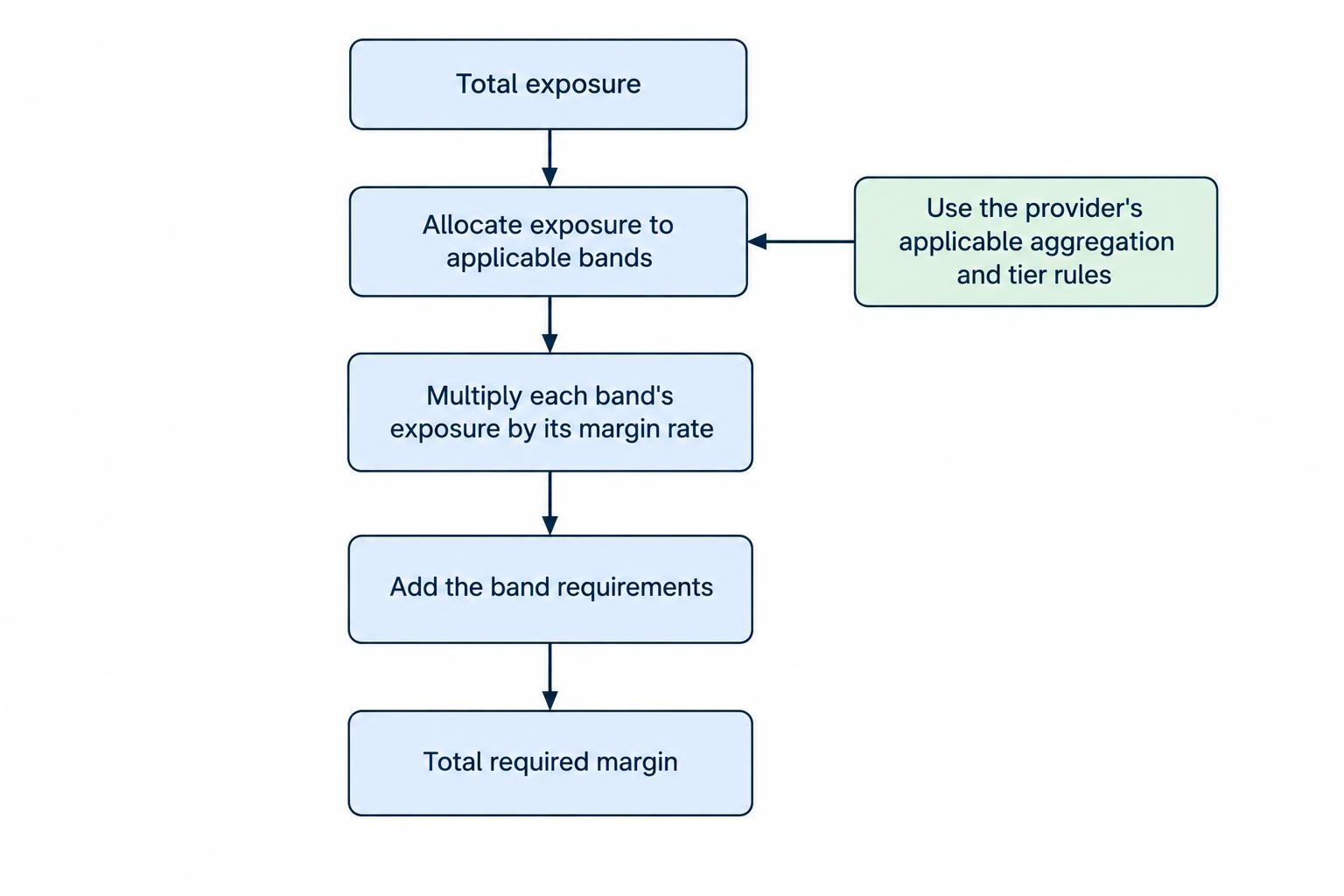
A flat rate calculator becomes unreliable when exposure crosses a margin band. Under a hypothetical schedule, the first £50,000 of exposure might require 5%, with the next £30,000 requiring 10%.
For £80,000 exposure, that produces £2,500 plus £3,000, or £5,500 margin. Applying 5% to the whole position would show £4,000 and understate the requirement by £1,500.
Check whether tiers apply to each trade or aggregated exposure in an instrument. An existing position may already occupy the lowest band. Also distinguish a schedule that charges each band separately from one that applies a new rate to the whole position.
Do not assume equal long and short positions cancel their margin requirements. In Australia, ASIC identified retail CFD margin discounts based on net exposure or only the larger opposing position as breaches of its product intervention order. Its January 2026 report on CFD distribution practices documents those findings.
The calculator should reproduce the applicable margin treatment, not assume that reduced directional exposure automatically means reduced collateral.
Choosing and Checking a CFD Margin Calculator
Choose a tool whose assumptions you can inspect. A spreadsheet can be useful for transparent arithmetic and scenario comparisons. An integrated calculator is preferable when it accurately imports the account’s contract terms, currency rates and existing positions. Connection alone does not guarantee correct inputs.
Before relying on a calculator, check that it provides:
- Clear contract inputs: units, lot size, point value and account currency should be visible.
- Traceable rates: show the margin schedule, conversion rate and time of the price input.
- Account impact: distinguish the proposed trade’s margin from projected total used and free margin.
- Sensible validation: reject invalid sizes, flag missing data and label estimates rather than presenting them as confirmed requirements.
Reconcile a small hypothetical trade against the platform’s order preview, then investigate any difference. Common causes include contract size, bid or ask selection, currency conversion, rounding and existing exposure within a tier.
Keep trading costs separate from collateral. Required margin is not itself a fee, but a trade still needs room for charges and adverse movement. For positions held overnight, use CFD overnight financing calculators alongside the margin estimate rather than treating the deposit as the trade’s full cash requirement.
When comparing CFD trading platforms, favour clear order previews and explainable calculations over a calculator that only displays maximum buying power. The useful question is how the proposed trade changes exposure and account resilience, not how much more the platform will let you open.