Building trading bots with Python means creating a system that receives market data, makes a repeatable decision, checks whether that decision is permitted, and manages the resulting order. The trading rule is only one part. Data quality, account state and recovery behavior deserve just as much attention.
Start with a narrow project: one account, one instrument type and one decision schedule. Make that version observable and recoverable before adding more strategies. If you are still choosing between a custom build and a managed development environment, compare the broader options in our guide to algorithmic trading platforms.
The approach below focuses on software design, not a profitable trading formula. A correctly implemented bot can still lose money.
Define the Trading Contract Before Writing the Bot
Write down what the strategy may observe, when it may decide and what it should produce. “Buy when the moving average rises” leaves too many questions unanswered. Does the calculation use a completed bar? What happens when data arrives late? Should an existing position grow after every repeated signal?
For an initial prototype, define one decision per completed bar, a fixed set of eligible instruments and a target position rather than an unconditional buy or sell instruction. Include the indicator warmup period, permitted trading sessions and behavior when required data is missing.
Keep strategy settings separate from operational settings. An indicator window belongs to the strategy; account permissions, maximum order size and the live trading switch belong to the operating configuration.
Also define what success means for the build. The first milestone should be reproducible decisions and correct position accounting, not an attractive return chart. Otherwise, a software defect can pass inspection simply because it made imaginary money.
Create a Reproducible Python Environment
Choose a Python version supported by the dependencies you intend to use, then create an isolated project environment. Record the interpreter version, operating system, dependency versions and strategy configuration alongside each release.
Pin direct dependencies and their dependencies rather than allowing production installations to select whatever versions happen to be available. Package hashes can also verify downloaded artifacts. The pip documentation on repeatable installations covers version pinning and hash checking. Neither replaces testing after an upgrade.
Keep research notebooks outside the live execution path. Use them to inspect data and investigate ideas, then move approved calculations into ordinary, testable modules. Avoid maintaining separate versions of the same indicator calculation for research and production.
Keep credentials outside the repository and deployment logs. Separate paper and live credentials, and require an explicit configuration change to enable live orders. A fresh installation should start with trading disabled, not inherit permission to spend money.
Build the Market Data Contract
Define a consistent internal record for incoming data. Useful fields include the instrument identifier, provider timestamp, receipt timestamp, bid, ask, trade price and data status. Preserve the distinction between a quote and a completed trade rather than treating every price as interchangeable.
Store timestamps consistently, preferably in UTC, while retaining the market timezone needed to interpret trading sessions. For each bar, record whether its timestamp represents the opening boundary or closing boundary and when the completed values became available.
Resampling needs particular care. Bar labels and interval boundaries can accidentally pull later observations into an earlier decision. The pandas time series documentation includes a warning about this form of future leakage. Choose boundaries deliberately, then test them with a tiny dataset whose expected output you can calculate manually.
Set explicit policies for missing observations, duplicate timestamps, late corrections and stale quotes. Do not silently fill a missing executable price and then treat it as a fresh trading opportunity.
For equities, document how historical price adjustments and corporate actions enter the dataset. For every market, verify that instrument identifiers, price increments and tradable quantities match the execution interface. A familiar ticker is not a complete instrument definition.
Separate Decisions, Risk Checks and Execution
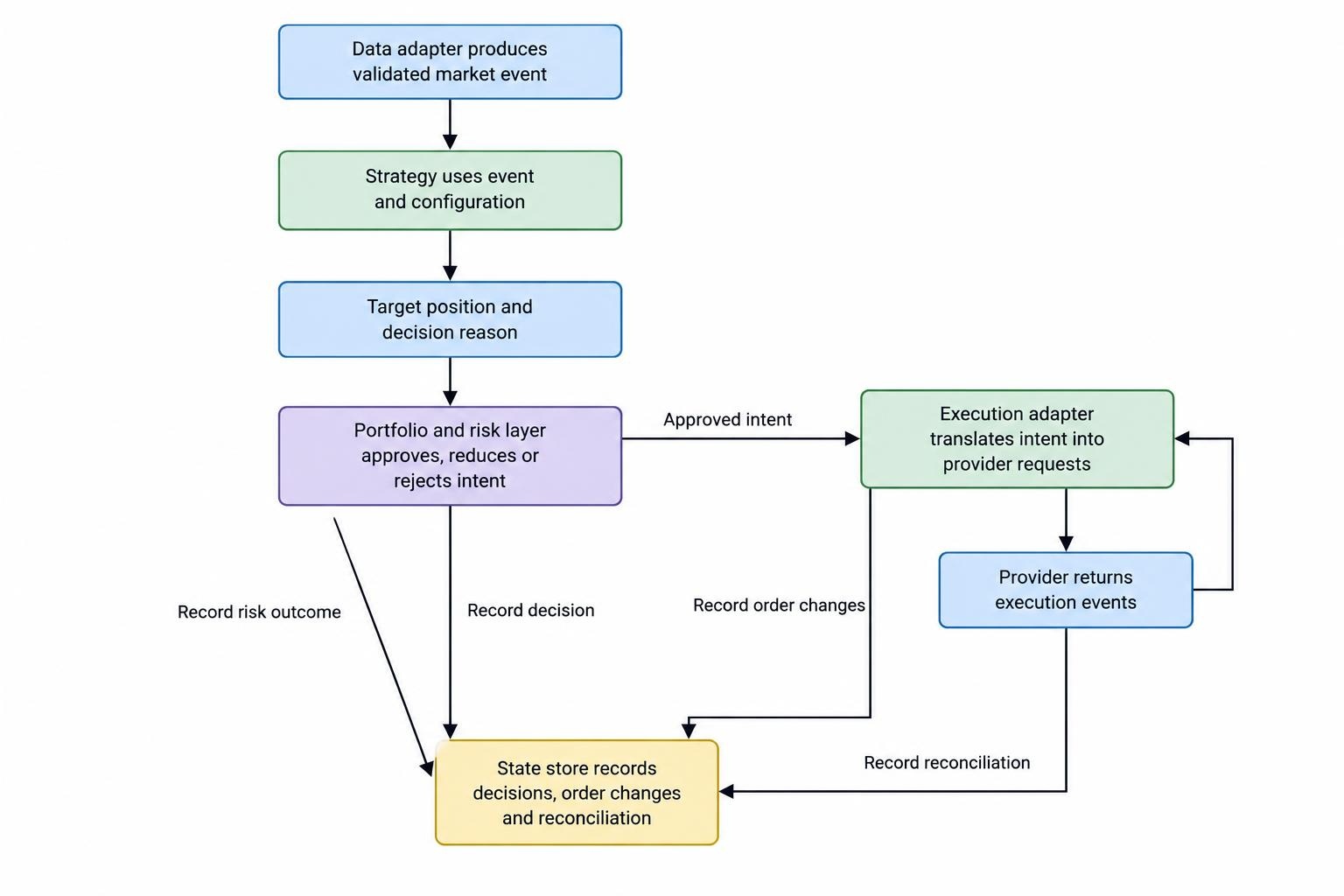
Organize the bot around responsibilities rather than putting the entire workflow inside one loop. Each component should accept a documented input and produce an output that can be inspected without placing an order.
| Component | Responsibility | Suggested output |
|---|---|---|
| Data adapter | Normalize incoming observations and identify data problems | Validated market event |
| Strategy | Evaluate eligible data using approved rules | Target position and decision reason |
| Portfolio and risk layer | Check proposed exposure against account constraints | Approved, reduced or rejected intent |
| Execution adapter | Translate approved intent into provider requests | Order references and execution events |
| State store | Preserve decisions, order changes and reconciliation records | Recoverable operating history |
Keep the strategy calculation independent of network calls. Given the same eligible data, configuration and portfolio snapshot, it should produce the same decision. Pass the decision time into the calculation rather than letting it read the computer clock whenever it wishes.
This separation also gives you somewhere to reject a trade without changing the strategy itself. A valid signal does not have to become an order.
Translate Target Positions Into Controlled Orders
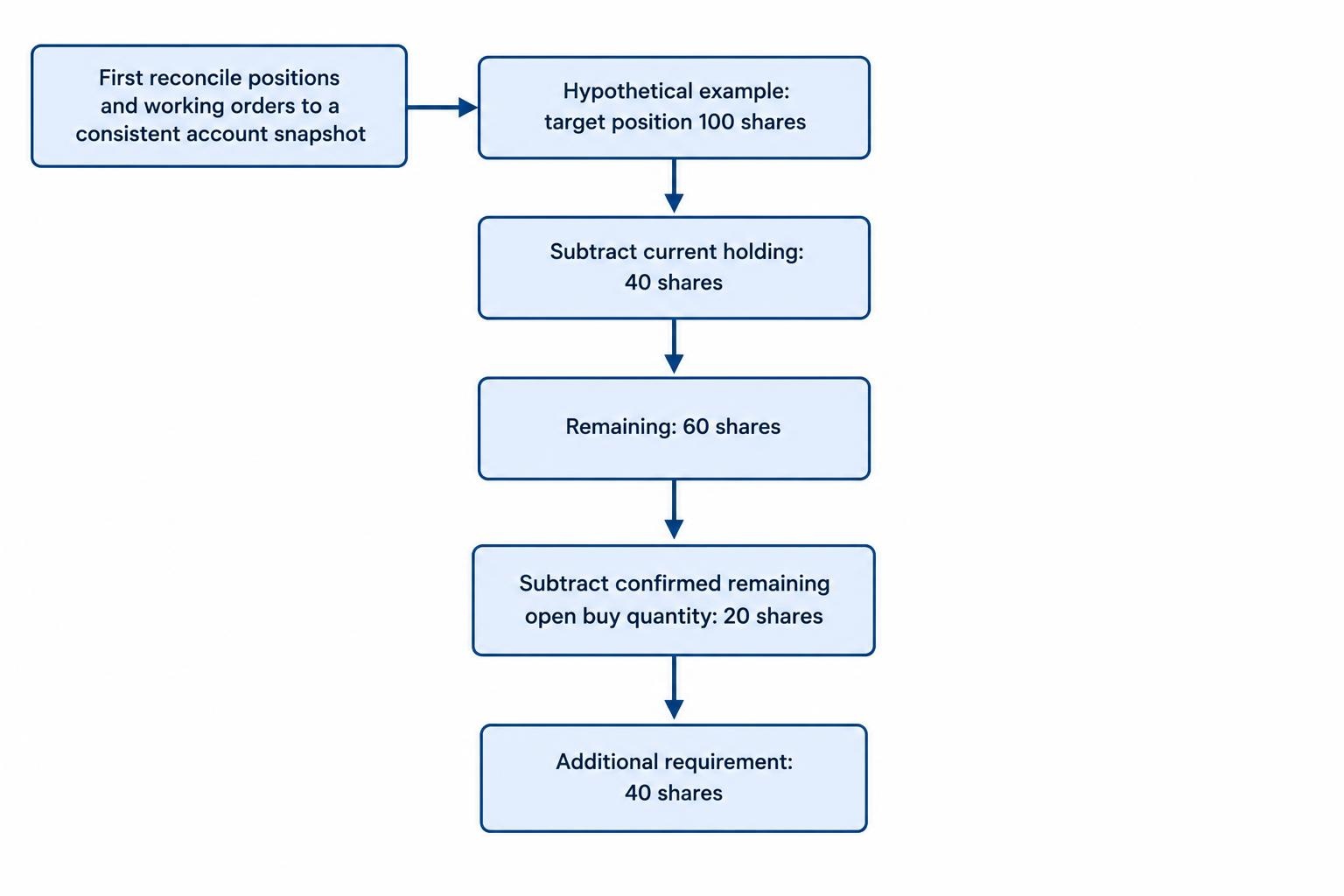
Have the strategy express desired exposure, then let the execution layer determine what remains to be done. Consider a hypothetical target of 100 shares. If the account holds 40 shares and a confirmed open buy order has 20 shares remaining, the additional requirement is 40, not 60.
That arithmetic assumes a consistent account snapshot. Reconcile positions and working orders before calculating another adjustment. Do not combine a recent fill update with an older open order snapshot and accidentally count the same quantity twice.
Define an internal order lifecycle that distinguishes submission, acceptance, partial execution and terminal outcomes. Track cumulative executed quantity separately from remaining quantity. Do not treat an accepted request as a completed trade.
Before selecting an integration, check authentication, supported order instructions, quantity rules, account data and execution updates. These choices belong in the interface contract; our guide to broker APIs for automated trade execution covers that selection process.
Treat an unanswered submission as unresolved, not automatically rejected. Require reconciliation before submitting a replacement. Use client order identifiers where supported, but verify their duplicate handling rules rather than assuming every interface provides the same protection.
Keep price and quantity rounding inside the adapter. The strategy should not need to know how each provider formats an order request.
Use Asyncio Where Concurrent Waiting Helps
For a prototype that checks completed bars at a modest frequency, start with the simplest execution model that meets its timing requirements. Add asynchronous processing when the application must wait on several streams, account updates or network responses concurrently.
Python’s event loop runs tasks cooperatively. Blocking work performed directly inside it delays other tasks, including data handling and order updates. The Python guidance on developing with asyncio covers blocking work, thread interaction and diagnostic tools.
Keep heavy research calculations away from the live event loop. Give network operations explicit timeouts and route state changes through a controlled update path rather than allowing several tasks to modify positions independently.
Define what happens when processing falls behind. Rejecting stale entry signals is a different decision from dropping execution updates; do not give both event types the same overflow policy.
Persist Enough State to Recover Safely
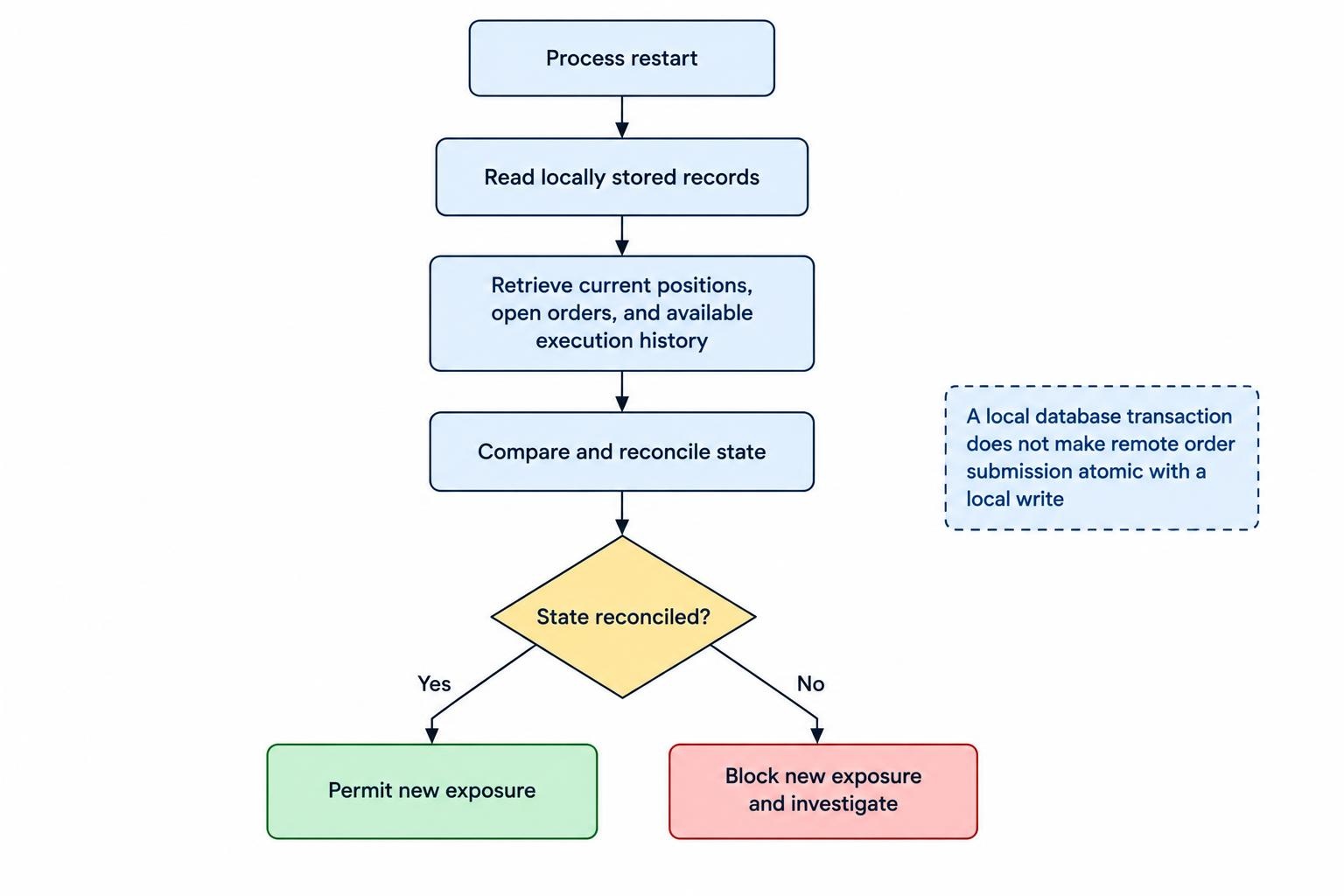
Design recovery before the first live session. Record the strategy version, decision identifier, input timestamps, target exposure, approved order intent and subsequent execution events. Persist approved intent before submission, while recognizing that a crash can still leave the submission outcome uncertain.
For a small deployment, consider SQLite for the local event ledger. Its transaction controls let you group related database changes under commit or rollback. Use that capability to keep linked local records consistent, with an explicit policy for write failures.
A database transaction does not make a remote order submission atomic with a local write. Plan for the gap between those two systems. On restart, compare stored records with current positions, open orders and available execution history before permitting new exposure.
Separate routine logs from the recovery ledger. A readable message helps an operator; a structured record helps the application reconstruct events. Store identifiers in both so you can follow one decision through approval, submission and execution without searching for a needle in a haystack of timestamps.
Test Behavior Before Testing Returns
Start with small tests whose expected outcomes are clear. Check indicator warmup, position arithmetic, quantity rounding, stale data rejection and repeated signals. Include boundary values rather than testing only comfortable inputs.
Parameterization lets one test run against multiple input and expected output combinations. The pytest documentation on parameterized tests provides the mechanism. Use it to check that the same risk rule behaves correctly below, at and above its configured threshold.
Then test event sequences through a simulated execution adapter. Include:
- A submission that receives no immediate response.
- An order that executes in several parts.
- A restart while an order remains open.
- A repeated event that must not change accounting twice.
Assert the resulting position, working quantity and permitted next action, not just whether the program avoided an exception. “It did not crash” is a rather low bar for software with account access.
Replay Historical Data Through the Same Logic
Feed historical observations through the strategy interface used by the live application. Preserve event order and make only information available at that decision time visible to the strategy. Keep simulated execution assumptions separate from signal calculations.
Include spread, fees, delayed execution and incomplete fills where relevant to the proposed trading process. Examine results outside the data used to choose parameters, and retain records of rejected experiments. Our guide to trading strategy backtesting software covers the wider evaluation workflow.
Progress Through Paper Trading Deliberately
Use paper trading to check scheduling, authentication, account synchronization, order instructions and alerts. Treat simulated fills as test outputs, not promises about live execution.
Set progression criteria before running the trial: no unexplained position differences, successful restart recovery and traceable decisions. If you proceed to a live trial, use an exposure budget you can afford to lose and keep the software under close supervision. Do not increase size simply because a short trial made money.
Deploy With Explicit Operating Limits
Before allowing live orders, configure maximum order size, position exposure, working order count and acceptable data age. Define a loss threshold together with its accounting basis: realized losses, unrealized changes, fees and the session reset time. Decide whether a breach blocks new exposure, cancels working entries or triggers another reviewed action.
Make missing account state a reason to block new exposure. Stopping new entries is not the same as canceling orders or closing positions, so provide separate controls. An emergency liquidation can itself involve execution risk.
Monitor data freshness, processing delay, rejected requests, unresolved submissions and reconciliation differences. Send alerts through a channel that does not depend entirely on the trading process remaining healthy. The design choices are covered further in our guide to trading bot monitoring and emergency stop controls.
Use a supervised process with persistent storage and an explicit startup check. After an unexpected exit, require reconciliation before reactivating entries rather than treating a successful restart as permission to trade.
For every release, retain the tested dependency set, configuration, test results and rollback plan. Make the next deployment a repeatable procedure, not an improvised repair while orders are working.