Binary options software performance claims need more scrutiny than a screenshot showing a winning streak. A high win rate does not establish profitability, a profitable backtest does not establish live performance, and a genuine account statement does not prove that the advertised software produced the results.
The useful question is whether a complete, reproducible record supports the claim after payouts, losses, costs and risk are accounted for. Before assessing returns, read the binary options risk warning. Performance evidence cannot make an unlawful offering acceptable or remove the possibility of losing the money committed.
Define Exactly What the Software Claims
Start by turning the advertisement into a statement that can be tested. “Up to 90% accuracy” leaves almost everything unanswered. Does that mean all signals, executed trades, the best trading session or the best settings selected after testing hundreds of alternatives?
Ask for the software version, measurement dates, assets, expiry lengths, account type and staking rules. Establish whether the results came from historical simulation, a demo account or trading with real money. These are different categories of evidence. Backtested results are hypothetical, not actual trading performance; the SEC investor bulletin on performance claims also addresses selective reporting and excluded costs.
Separate signal accuracy from execution performance. A direction forecast might be correct at its publication time but produce a losing contract after an entry delay. The claim should identify which outcome it measures, rather than switching definitions whenever one looks better.
Request Records That Allow the Result to Be Rebuilt
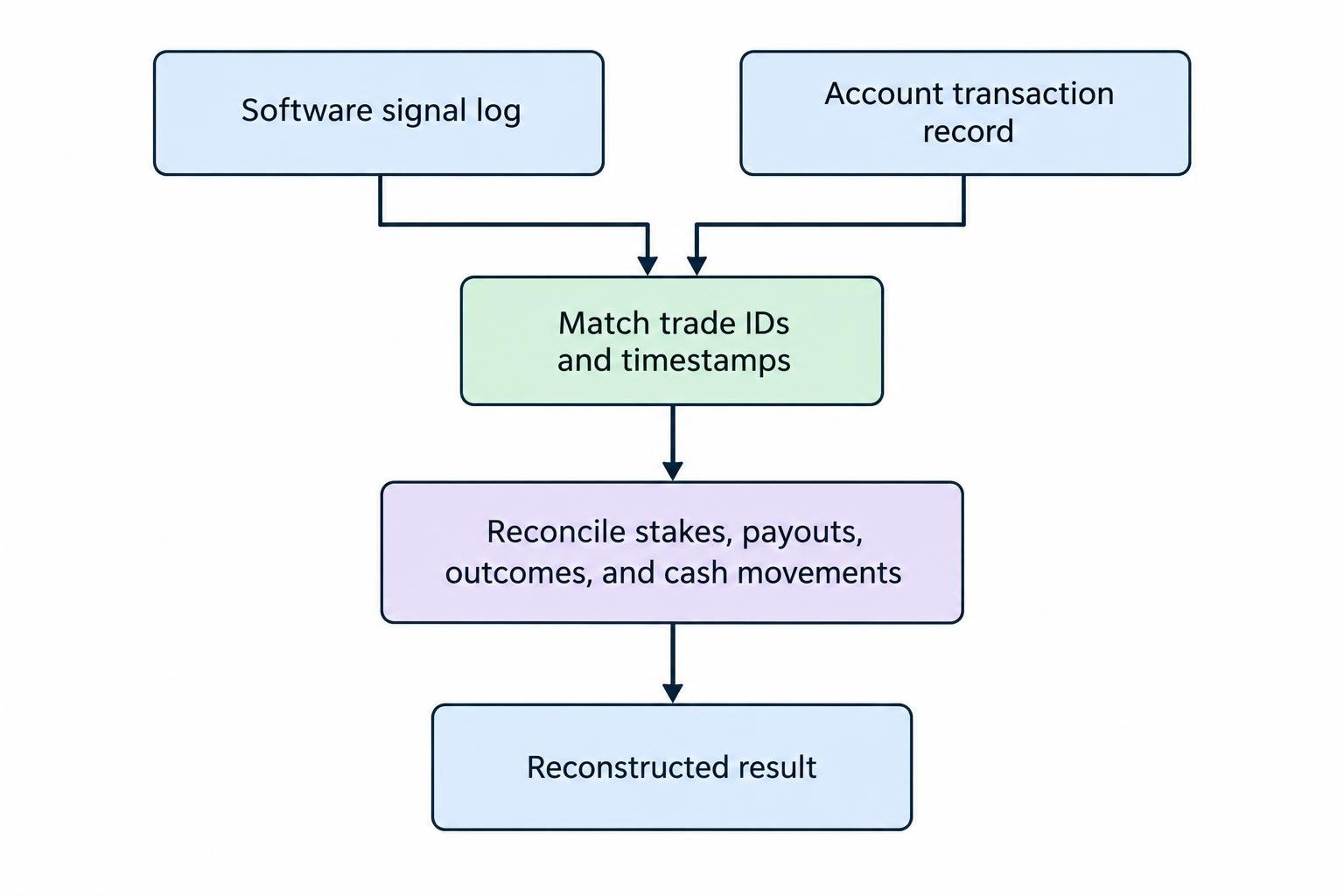
A screenshot establishes what appeared on a screen, not how the figures were calculated. Request an export covering a continuous period, including losing sessions and gaps in activity. The objective is to reconstruct the advertised result without relying on the vendor’s summary.
A useful evidence package should include:
- Trade identity: account identifier, contract or transaction ID, asset and direction.
- Timing: signal publication, order acceptance and expiry, with the time zone stated.
- Contract terms: entry level, settlement level, stake and payout available when accepted.
- Outcome: win, loss, refund, cancellation or rejection, with the financial result.
- Account movements: deposits, withdrawals, bonuses, charges and balance adjustments.
Keep account identifiers consistent while protecting personal information. Match the software’s log against the account’s transaction records rather than accepting two reports generated by the same application. The process for exporting and analysing binary options trading history provides a separate framework for organising those records.
Reconcile the balances too. Starting funds, external cash movements, trading results and charges should explain the ending balance. A deposit is not profit. Any unexplained difference should remain unresolved rather than disappearing into a convenient “adjustment” column.
Convert the Win Rate Into Net Profit
The examples here concern contracts where a win returns the stake plus a stated profit percentage, while a loss forfeits the stake. Do not apply this calculation unchanged to contracts bought and sold at quoted prices, or arrangements with different loss and refund terms.
If a winning trade earns 80% of the stake and a losing trade loses 100%, the required win rate is above 50%. With equal stakes, no refunds and no extra charges:
Break even win rate = 1 ÷ (1 + profit payout rate)
At an 80% profit payout, that is 1 ÷ 1.80, or approximately 55.56%. Confirm that “80% payout” means an 80% profit plus the returned stake, not an 80% total repayment.
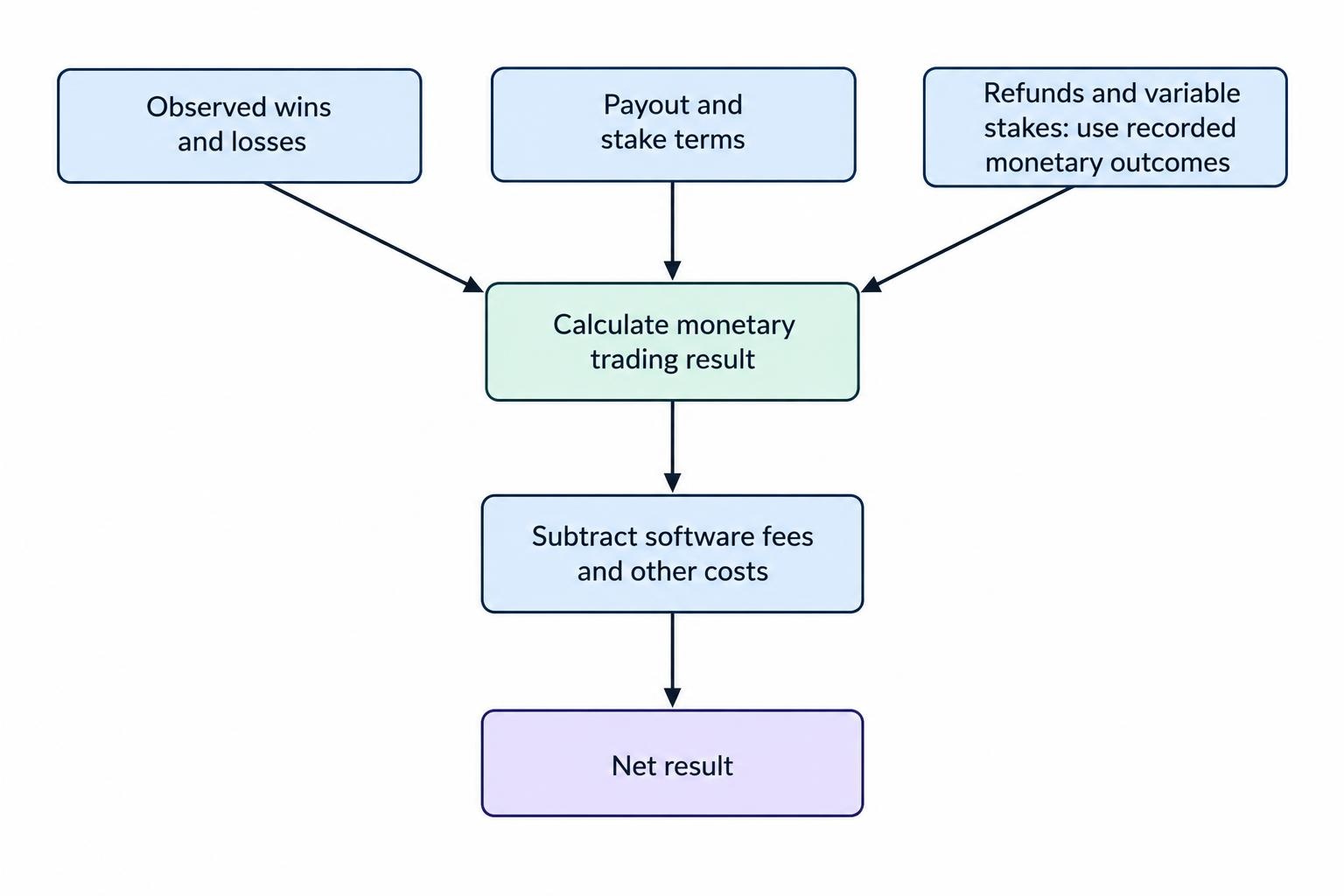
Consider 100 hypothetical trades at $10 each. Sixty wins earning $8 produce $480, while 40 losses cost $400. Trading profit is $80 before other costs. A $100 software subscription turns that period into a $20 loss. If the profit payout were 60% instead, the same 60% win rate would lose $40 before subscription costs.
Use the payout recorded for each trade, not the largest percentage advertised. When stakes vary, calculate the actual monetary result rather than multiplying an average payout by the win rate. The binary options payout and break even calculators cover these relationships in more detail.
Report refunded trades separately and state the win rate denominator. Excluding refunds can be reasonable, hiding them is not. Also distinguish return on total stakes from return on account capital: repeated use of the same cash makes those percentages very different.
Assess Sample Size and Statistical Uncertainty
There is no universal trade count that proves a strategy works. The distance above the payout threshold matters, as do dependence between trades and changes in trading conditions. Thirty wins from 50 trades and 600 wins from 1,000 trades both produce a 60% win rate, but not the same precision.
The following calculated examples use the NIST Wilson confidence interval method. They assume independent win or loss outcomes with an unchanged underlying win probability.
| Trades | Wins | Observed win rate | Approximate 95% Wilson interval |
|---|---|---|---|
| 50 | 30 | 60% | 46.2%–72.4% |
| 100 | 60 | 60% | 50.2%–69.1% |
| 1,000 | 600 | 60% | 56.9%–63.0% |
The 100 trade interval extends below the 55.56% threshold for an 80% profit payout. The 1,000 trade interval sits above it, under the stated assumptions and before costs. Neither calculation establishes that future trading conditions will remain unchanged.
Inspect how the observations were collected. Ten overlapping positions responding to the same price movement should not automatically count as ten independent tests. Request results across separate dates, sessions and market conditions, not just a larger transaction count.
Set the assessment period before observing results. Stopping the test at the first attractive winning streak introduces another selection decision that the headline percentage does not reveal.
Check Whether the Test Benefited From Hindsight
A long backtest can still provide weak evidence if the vendor selected its settings using the same history. Ask how many indicators, assets, expiry lengths and parameter combinations were tried before the advertised version was chosen.
Choosing the best result from many trials creates a risk of selecting noise rather than a repeatable advantage. The research paper The Probability of Backtest Overfitting examines this strategy selection problem. A vendor should disclose the search process, not present the surviving configuration as though it were the only one tested.
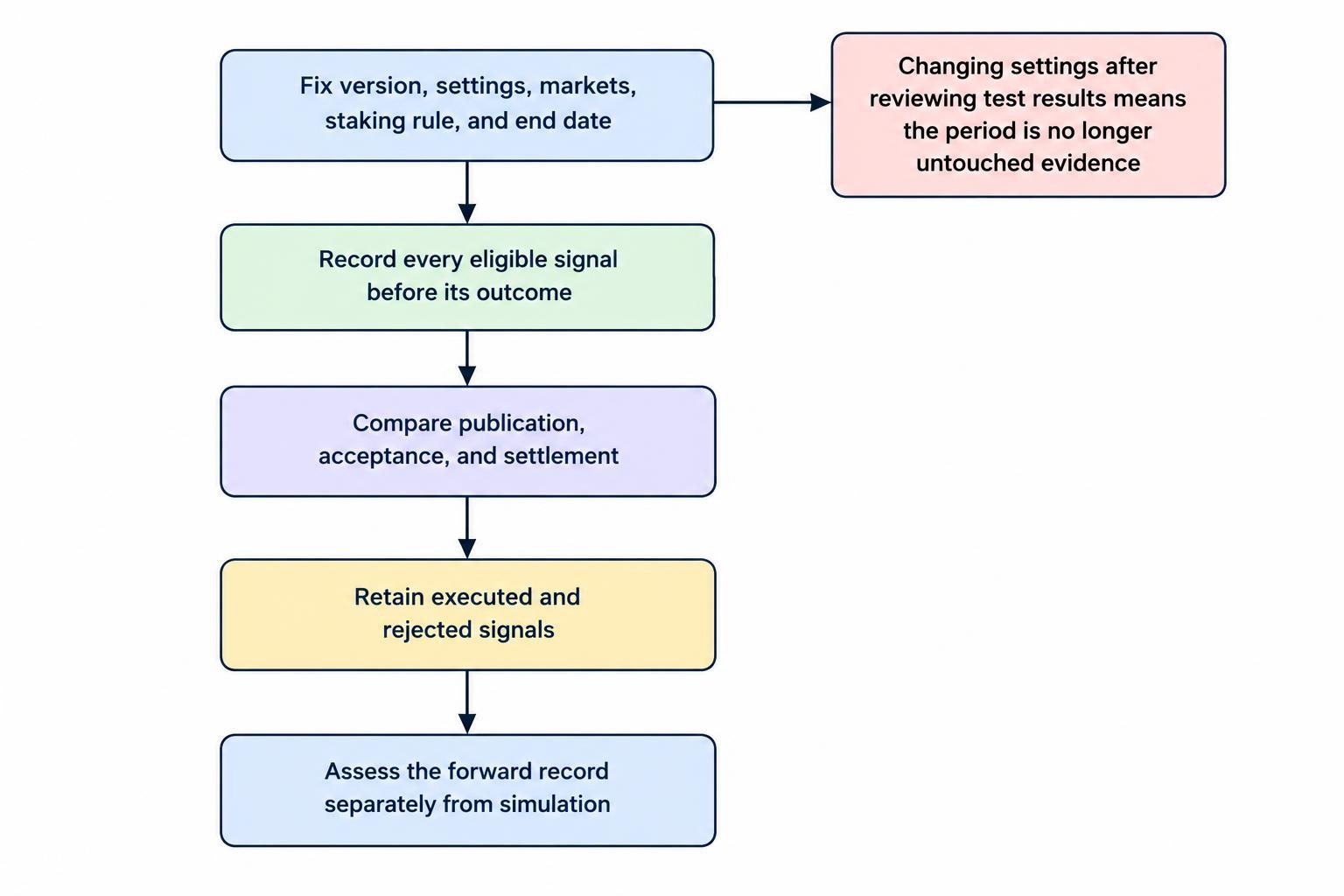
Request results from data that did not influence development, followed by testing on later observations. Once settings are changed in response to a test, that period is no longer untouched evidence. Repeatedly consulting a “holdout” period defeats its purpose.
For binary options software, inspect the timing assumptions. Could the signal have been calculated using only information available before entry? Was the advertised payout available then? Did the data identify the contract’s settlement value, or did the simulation substitute a convenient candle close?
Also check whether historical indicator signals change after later prices arrive. An arrow that appears only after the outcome was known is not evidence of a usable trading signal.
Use Forward Testing to Check Reproducibility
A forward test records decisions before their outcomes are known. Fix the software version, settings, eligible markets, staking rule and end date in advance. Preserve timestamps and record every eligible signal, including signals that could not be executed.
Compare signal publication with order acceptance and settlement. Record rejected orders rather than silently removing them. If the report measures only accepted trades, it should still show how many signals were rejected and why.
A simulator can help check whether the software behaves consistently without committing funds. Use binary options demo software and simulators to assess operation and record keeping, not to assume that simulated profits will transfer to a live account.
Where live comparison is lawful and appropriate, label it separately from simulation. A month of results is a start, it is not a verdict.
Look for Risk Hidden Behind a Smooth Win Rate
Ask whether the report counts individual contracts or groups several attempts into a single “successful sequence”. A sequence with multiple losing trades followed by one winner can look flattering when only the final outcome receives a label. Require both contract level results and the complete financial result of each sequence.
Inspect stake changes after losses. A martingale style system can concentrate a large amount of money in a small number of later trades, making a percentage of winning sequences a poor description of risk.
Consider an illustrative sequence with stakes of $10, $20, $40, $80 and $160. Five losses cost $310. Even if a subsequent $320 trade wins at an 80% profit payout, its $256 profit leaves the sequence $54 down. Doubling does not automatically recover losses when the winning profit is smaller than the amount risked.
Request the largest stake, maximum simultaneous amount at risk, longest losing run and maximum drawdown. Specify drawdown as the fall from an account peak to a later trough, adjusted for external cash movements. Check whether open commitments were included or whether the chart shows only settled balances.
Verify Both the Reviewer and the Provider
“Independently verified” needs an explanation. Identify who performed the check, whether they were paid, what records they accessed and what their report actually covers. Verifying account transactions is not the same as verifying the software’s decision rules, and neither establishes that every customer received comparable results.
Separate platform risk from strategy performance. Regulators have received complaints involving denied withdrawals and software manipulation designed to generate losing trades, including altered expiry countdowns. These allegations are documented in the joint CFTC and SEC alert on binary options fraud. A dashboard balance alone does not resolve those concerns.
Check commercial incentives too. Ask whether a reviewer receives subscription revenue, referral payments or compensation tied to customer deposits or activity. Such relationships do not automatically invalidate a report, but they should be disclosed alongside its methods and exclusions.
For a US offering, verify the identities and relevant registration status of the entities involved before providing funds or account access. The CFTC binary options fraud resource directs users to registration checks and disciplinary history. Treat this as a separate assessment from profitability, not a box that strong returns can tick on its behalf.
Decide What the Evidence Actually Supports
Classify the claim as unsupported, supported only by simulation, supported by a narrow live record, or supported by a reproducible record with disclosed conditions. Avoid turning those categories into a simple safe or unsafe badge.
A useful record lets you rebuild net results, inspect uncertainty, identify stake escalation and distinguish development results from later testing. Missing losses, unexplained balance changes, undisclosed payout assumptions or a refusal to provide records are reasons to withhold reliance on the claim.
Even strong historical evidence supports only a qualified statement about the period examined. It does not promise future income. If the sales pitch requires treating a winning percentage as a guarantee, the evidence has already been asked to do a job it cannot do.