Binary options demo software lets you practise entering contracts, choosing expiry times and reviewing outcomes with virtual money. A simulator can serve the same purpose without connecting to a trading account, using live prices, historical replay or manually entered data.
The useful question is not how quickly the virtual balance grows. It is whether the software reproduces the contract rules accurately and leaves enough evidence to check every result. A demo that makes winning easy teaches very little about trading.
Access also requires care. Binary options can trade on registered US exchanges, but many online platforms promote unregistered offerings. The CFTC’s binary options fraud guidance distinguishes registered exchange trading from offshore platforms associated with fraud. A working practice account does not establish that its operator can lawfully accept your money.
Demo Accounts and Standalone Simulators
A demo account is usually a practice mode within a trading platform. A standalone simulator separates the exercise from the provider’s account system. Neither format is automatically more accurate: accuracy depends on the prices, contract terms and execution assumptions behind the interface.
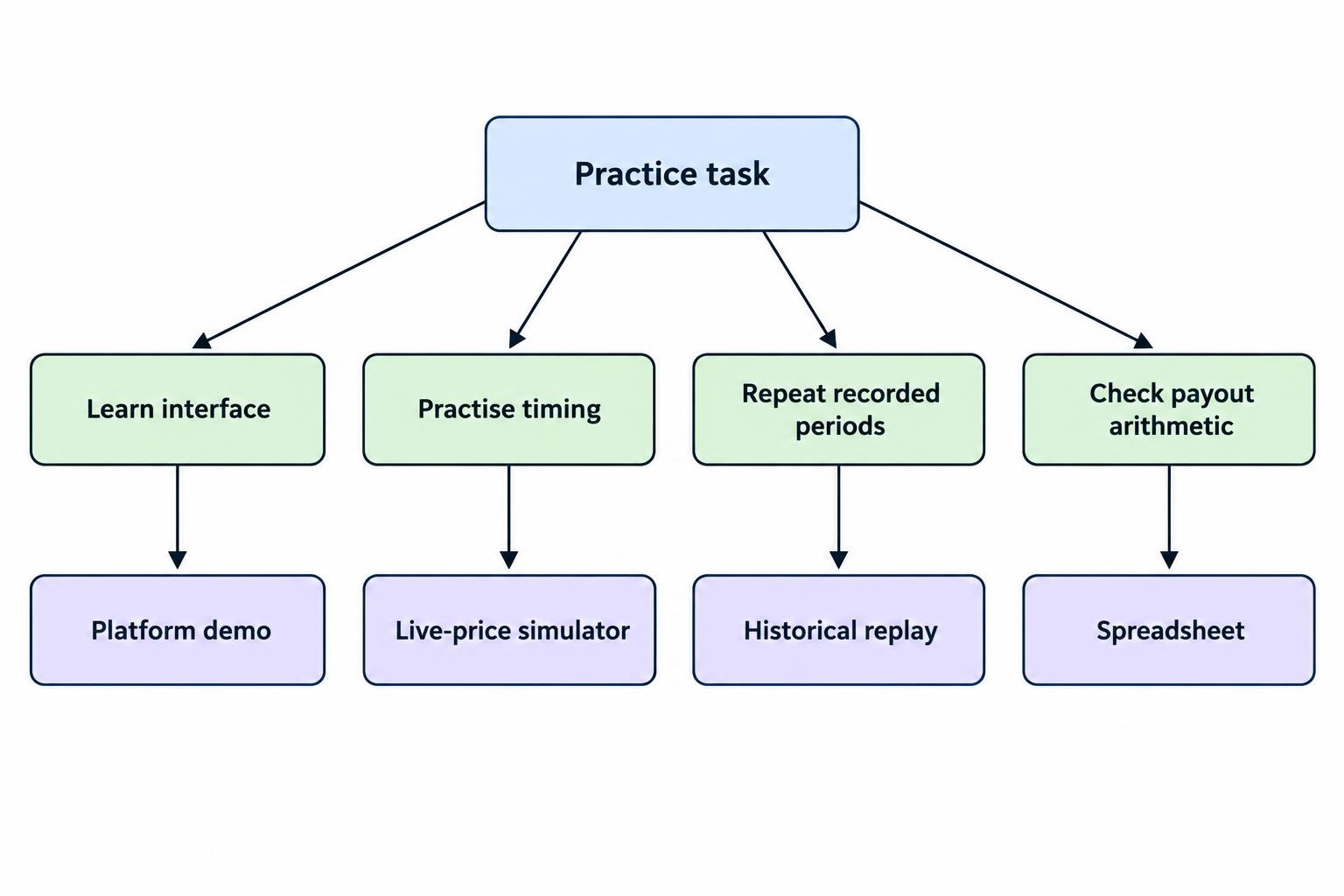
| Practice format | Main use | What to check |
|---|---|---|
| Platform demo account | Learning the interface, order ticket and expiry selection | Whether demo contract terms and execution rules match the documented live offering |
| Live price simulator | Practising decisions as new prices arrive | Data delays, settlement source and treatment of orders entered near expiry |
| Historical replay simulator | Repeating exercises across recorded market periods | Whether future prices remain hidden and timestamps support the chosen expiry |
| Spreadsheet simulator | Checking payout arithmetic and recording decisions | Manual entry errors, consistent rules and whether results can be independently reproduced |
Choose the format around the task. Interface practice needs a representative order ticket. A timing exercise needs sufficiently detailed data. Payout analysis may need nothing more elaborate than a spreadsheet. The broader binary options software category covers other functions; a demo should be judged on what it can actually simulate.
Features That Make Practice Worthwhile
Clear contract and settlement rules
Before placing a virtual trade, you should be able to identify the underlying market, strike or reference level, direction, expiry, amount at risk and possible payment. The software should also state what happens when the settlement value equals the strike. Do not assume an equal result always produces a refund.
Settlement deserves more attention than the chart’s appearance. A contract might use a defined index, a named price source or an average calculated over a stated period. The simulator should reproduce that method rather than settle against whichever chart happens to be visible.
Two displays labelled with the same market name are not enough to establish that their prices are interchangeable. Check the instrument, timestamps and settlement rules before comparing results. The guide to comparing binary options platform price feeds covers those checks in more detail.
Usable timestamps and realistic order handling
The order record should distinguish when you clicked, when the order was accepted and when the contract expired. A countdown alone cannot explain whether a late order qualified for the displayed expiry.
Check whether the software models rejected orders, changing quotes and unavailable contracts. If it accepts every click instantly, treat the exercise as decision practice rather than evidence of executable performance. For an exchange style simulator, inspect how it handles bid and ask prices, available quantity and fees.
Historical replay needs suitable data resolution. A one minute candle cannot reliably reconstruct every price within that minute. If an entry or expiry falls between recorded observations, the simulator must disclose its approximation. Otherwise, the displayed precision exceeds the data behind it.
Permanent records and adjustable settings
Useful controls include an editable starting balance, configurable position sizes and downloadable history. Resetting the balance should not erase the records needed to review earlier sessions. Browser, desktop and mobile versions should preserve the same contract details, even if their screen layouts differ.
Also check access conditions before investing time in setup. Does the practice account expire? Can data be exported without upgrading? Are prices included, or does the simulator require a separate data subscription? A free interface is not necessarily a free practice environment.
Check Payout Arithmetic Before Trusting the Balance
A high win rate can still produce a loss. The relationship between winning payments and losing stakes matters more than the number of green results.
Consider a hypothetical fixed return contract with a $20 stake and an 80% net profit on a win. A winning trade adds $16 after returning the original stake; a losing trade removes $20. With no refunds or extra charges, the break even win rate is:
Break even win rate = 1 ÷ (1 + 0.80) = approximately 55.56%.
Across 100 trades, 55 wins generate $880 in profit and 45 losses remove $900. The result is a $20 loss, despite winning more often than losing. These are illustrative calculations, not a performance forecast.
Check what the platform means by “payout.” It may display the total returned, including the stake, rather than net profit. The binary options payout and break even calculator guide examines that distinction and the effect of different payment terms.
Exchange style contracts need different inputs. In a hypothetical contract bought for $40 that settles at either $100 or zero, the buyer’s profit is $60 on a successful settlement and the loss is $40 otherwise, before fees. A simulator should not apply a fixed percentage payout model to that contract.
Build a Practice Routine You Can Audit
Unstructured clicking mostly tests how quickly you can change your mind. A repeatable exercise produces a record that can expose mistakes in either the trading rules or the software.
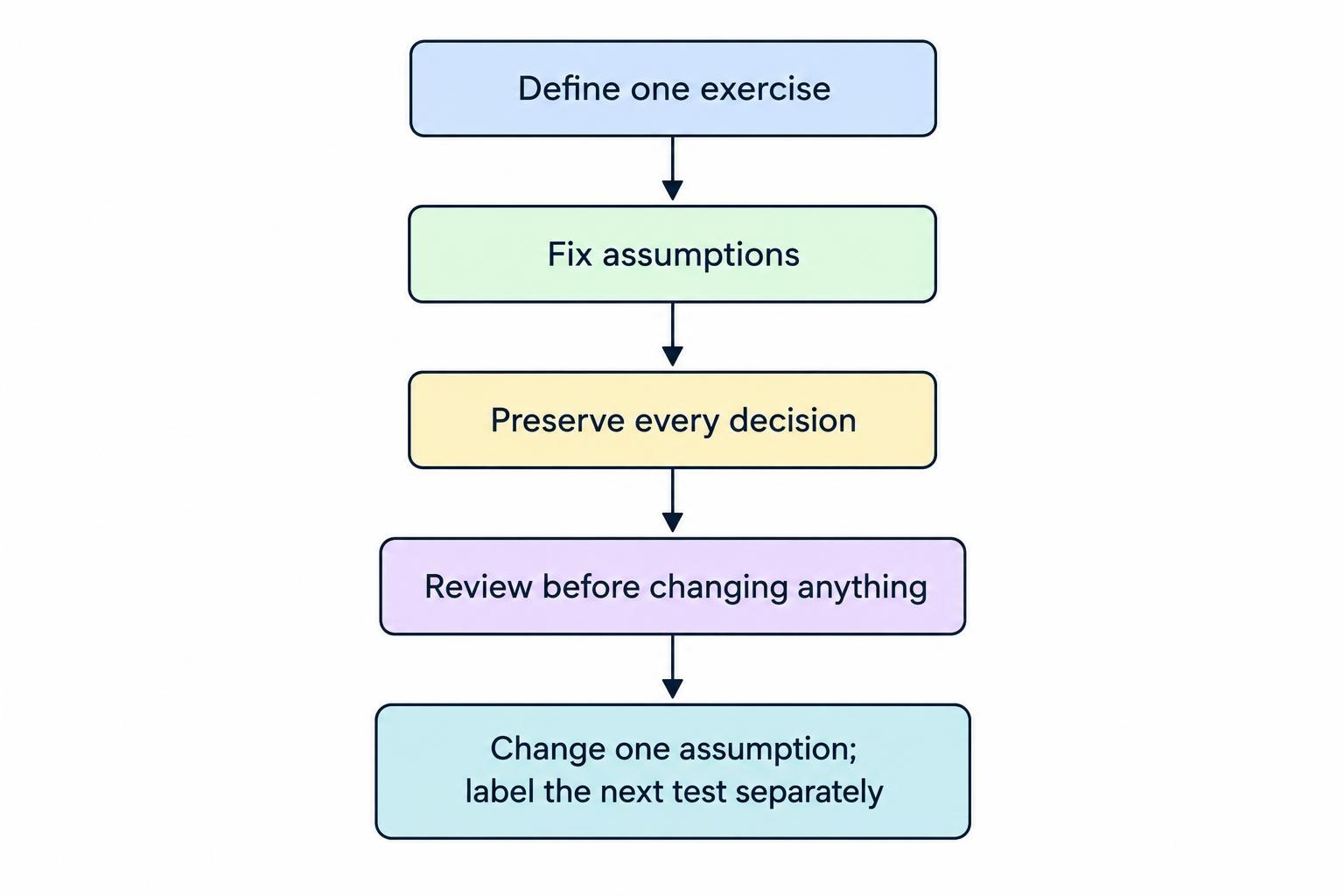
- Define one exercise. Choose one contract structure, one expiry rule and a written entry condition. State when you will skip a trade.
- Fix the assumptions. Record the starting balance, position size, payout or contract price, fees and maximum permitted session loss.
- Preserve every decision. Keep accepted trades, rejected orders, skipped signals and any changes to the rules. Do not reset away an inconvenient session.
- Review before changing anything. Separate interface mistakes, settlement discrepancies and strategy losses. Change one assumption at a time, then begin a separately labelled test.
Use a balance and position size that make the exercise meaningful. A very large virtual account can hide the effect of a losing run. Increasing the stake after losses also changes what is being tested: it is no longer the original fixed stake exercise.
The record should retain entry and expiry times, contract terms, amount at risk, quoted payment, settlement value, fees and net result. Add a short reason for entry and note whether the written rule was followed. A screenshot can help investigate a discrepancy, but it should not replace structured records.
Download the history before resetting, changing devices or letting access expire. The process for exporting and analysing binary options trading history provides a framework for reviewing those records without relying on a platform’s summary screen.
There is no universal number of demo trades that proves readiness. One hundred trades can be a manageable review batch, but the number itself establishes nothing. Many trades taken during one short market episode may reveal less than their count suggests.
What Demo Results Cannot Prove
Simulated returns are not actual trading returns. They cannot fully reproduce financial pressure, and execution assumptions may misrepresent liquidity or price changes. Those limitations are addressed in the NFA’s notice on hypothetical performance results. They matter even when a practice platform uses current market prices.
Distinguish live demo practice from historical testing. Replay creates a hindsight problem if you have already seen the price sequence. Live practice avoids that particular problem, but it still does not establish how you would respond to losing real money or whether equivalent orders would execute.
Virtual profits also cannot test withdrawals, custody arrangements or the provider’s willingness to honour account balances. A successful demo session offers no evidence about those matters. The practice environment and the operator’s conduct are separate questions.
Be cautious with screenshots, leaderboards and demonstrations showing only profitable sessions. Ask whether the complete record exists, whether balances were reset and whether the assumptions remained unchanged. The guide to evaluating binary options software performance claims covers the evidence needed to assess those presentations.
Judge progress through process measures as well as profit and loss. Can you explain every settlement? Are order errors falling? Does the exported history reconcile with the balance? Those questions are less flattering than a rising equity curve, but more useful.
Protect Your Data Before Opening a Demo
Virtual money does not remove privacy or fraud risks. The joint CFTC and SEC investor alert documents complaints involving identity theft, refused withdrawals and software manipulation. These concerns make operator checks relevant before submitting personal information, not just before depositing.
For basic practice, prefer access that does not require a deposit or payment card. Verify the operator independently before uploading identity documents. Do not send card images or account credentials to an unknown sales contact, and do not install remote access software to activate a demo.
Separate necessary account verification from pressure selling. Explainable identity checks by a verified operator are different from a caller demanding documents and an immediate deposit. If the provider cannot clearly explain what data it collects and why, stop the registration process.
A deadline to “keep your demo profits” should not influence a funding decision. Treat any proposed conversion of virtual gains into withdrawable money as a separate offer requiring its own checks. Practice results are not cash owed to you unless enforceable terms establish otherwise.
Check Local Restrictions Before Considering Live Trading
A demo login is not proof that the associated live product is available lawfully where you live. Check the operator’s legal entity, regulatory status and the exact product being offered. A registration badge alone does not establish permission for every activity advertised.
In the UK, the FCA’s permanent retail binary options prohibition took effect on April 2, 2019, covering sale, marketing and distribution by firms carrying out activity in or from the UK. An accessible offshore demo does not override that restriction.
Australia also restricts the product: ASIC extended its ban on issuing and distributing binary options to retail clients until October 1, 2031. Educational simulation should remain separate from any assumption that opening a funded account is permitted.
Choose for Auditability, Not a Flattering Balance
The most useful binary options simulator makes its assumptions visible. It states the contract rules, identifies the settlement method, records order timing and lets you preserve results outside the application. It also makes clear which parts of trading it does not reproduce.
Reject software that cannot explain a settlement, conceals payout calculations or makes continued practice dependent on an urgent deposit. More indicators will not repair missing records.
A demo has done its job when you can account for both winning and losing outcomes without guesswork. That may lead you to continue studying, change the exercise or decide against live trading. None of those outcomes requires turning a virtual balance into a funded account.