Dividend tracking software records investment income, organizes upcoming payments and estimates what a portfolio might produce over the next year. Its value goes beyond putting payment dates on a calendar. A useful tracker separates money received from money expected, accounts for reinvestment and shows what remains after withholding taxes and fees.
The right choice depends on how much bookkeeping your portfolio creates. A few domestic holdings may suit a spreadsheet. Multiple accounts, foreign payments and dividend reinvestment can justify more automation. If you already use portfolio tracking software, check its income reporting before paying for a separate dividend app.
What Dividend Tracking Software Should Record
A dividend tracker needs a transaction ledger, not just a yield figure beside each stock. You should be able to open any payment and trace the amount back to the holding, account and supporting statement. That matters when the same security sits in several accounts with different share quantities.
Look for these fields when reviewing a tracker or building your own:
| Record | What it should show | Why it matters |
|---|---|---|
| Holding and account | Security identifier, account and eligible share quantity | Prevents payments being assigned to the wrong position |
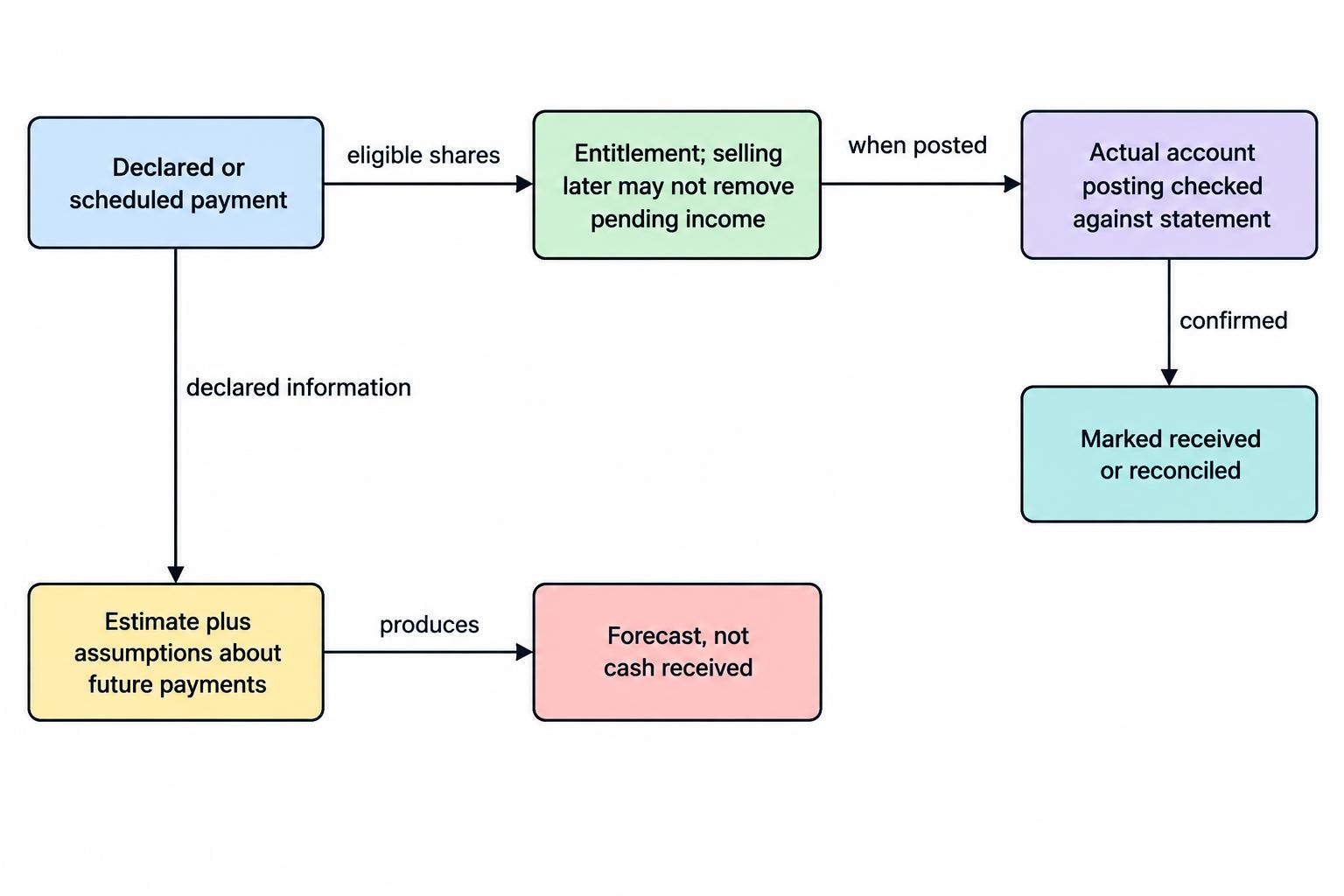
| Dividend dates | Ex-dividend date, scheduled payment date and actual posting date | Separates entitlement from cash receipt |
| Gross payment | Dividend per share multiplied by eligible shares | Provides a starting point for reconciliation |
| Deductions | Withholding taxes and payment fees recorded separately | Explains the difference between gross and net income |
| Currency | Original payment currency, conversion rate and account currency | Keeps foreign income calculations traceable |
| Payment status | Estimated, declared, received and reconciled | Stops forecasts from masquerading as spendable cash |
Manual corrections should preserve an explanation of what changed. A corrected withholding amount is useful; an unexplained adjustment that makes the total look right is a problem postponed.
Keep Dividend Calendars Separate From Forecasts
A calendar answers when a payment is scheduled. A forecast estimates future income. Those are different jobs, and the interface should make the distinction obvious.
For ordinary U.S. cash dividends, buying on or after the ex-dividend date generally does not entitle the buyer to the upcoming payment. Special distributions can follow different rules. Use the published event dates rather than a homemade settlement calculation; the SEC’s explanation of ex-dividend dates covers both ordinary payments and exceptions.
A tracker should calculate an upcoming payment using the eligible quantity, not simply today’s share count. If you sell after entitlement has been established, the payment may still belong in your income record even though the holding has disappeared from your current positions.
For projections, inspect the assumptions. Multiplying the latest quarterly dividend by four assumes that payment continues unchanged. Repeating a special dividend or an unusually large fund distribution can inflate the forecast. Prefer software that labels declared payments separately from estimates and lets you exclude nonrecurring amounts.
Automatic Dividend Entries Still Need Checking
Automation can generate a dividend from security event data and your recorded trades. That saves typing, but it does not prove the money reached your account. Missing purchases, incorrect sale dates or incomplete reinvestment records can all produce the wrong expected amount.
Sharesight provides a useful example of this distinction. Its automatically generated dividends depend on recorded trades and provider data, and remain unconfirmed until checked against your records. The Sharesight documentation on generated dividends also notes that amounts may need adjustment, including for currency differences.
During a trial, find out whether imported cash transactions replace generated entries, match against them or sit beside them. Two entries for one dividend will make the income chart look excellent. Your bank balance will remain unimpressed.
Also check how the software handles corrected transactions. You need a way to reverse or amend an entry without importing the entire account again.
Track Reinvested Dividends Without Double Counting
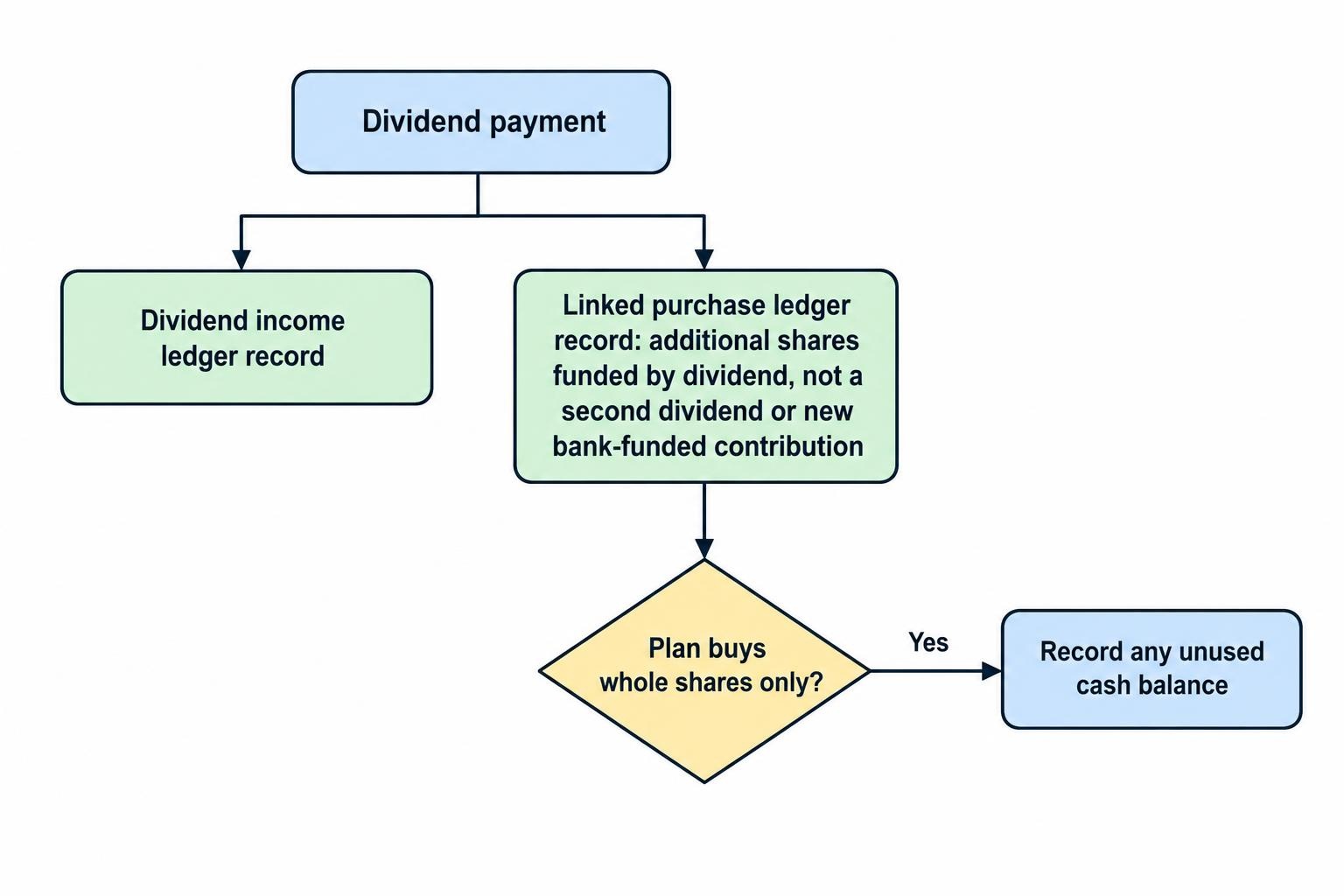
A dividend reinvestment plan, often called a DRIP, creates two linked events: dividend income and a purchase of additional shares. Recording only the income leaves the share count wrong. Recording only the purchase loses the income history.
Suppose a hypothetical holding pays a $100 dividend, and the entire amount buys shares at $40 each with no deductions. The tracker should record $100 of income and a purchase of 2.5 shares. It should not treat that purchase as another $100 of income or as a new contribution from your bank account.
For U.S. federal tax purposes in a taxable account, reinvesting a dividend generally does not remove the income reporting obligation. Records of the resulting purchases also matter for establishing the shares’ cost basis. The IRS guidance on reinvested dividends and stock basis addresses both points.
Check fractional share precision, purchase dates, fees and leftover cash. If a plan buys whole shares only, the tracker should retain the unused balance rather than invent a fractional purchase. Reports should also distinguish reinvested income from cash available to withdraw.
Preserve the Detail Behind Foreign Dividend Payments
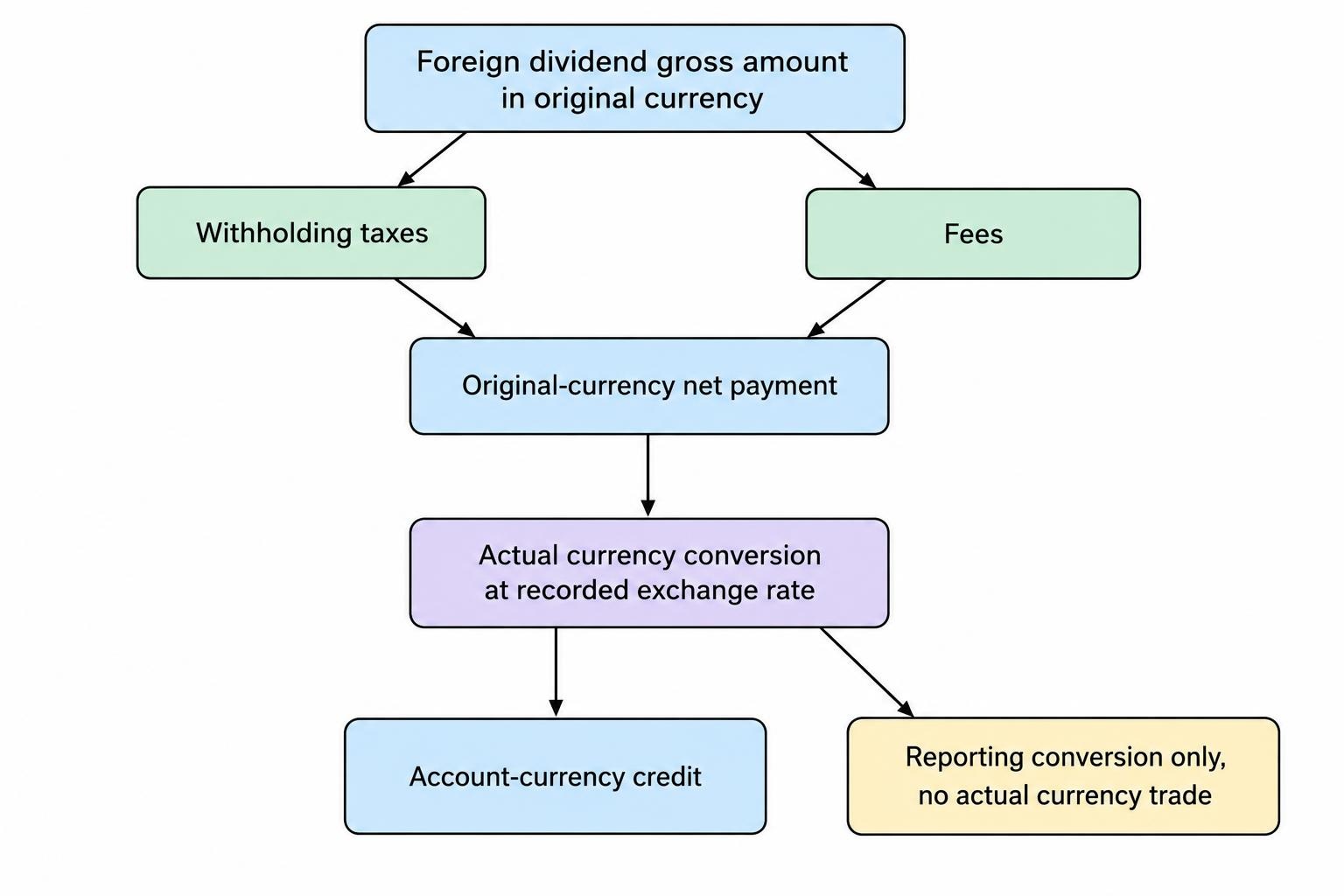
Foreign dividends need more than a converted total. Keep the original gross amount, deductions, net payment and exchange rate. Otherwise, a change in reported income becomes difficult to explain: did the dividend change, did withholding change, or did the currency move?
Portfolio Performance supports separate dividend fields for gross value, fees, taxes and an editable exchange rate when currencies differ. Its dividend transaction documentation shows the distinction between the original payment and the net credit.
Consider a hypothetical €100 dividend with €15 withheld and a €1 fee, both deducted before conversion. The net payment is €84. At an assumed conversion rate of $1.10 per euro, the account receives $92.40. Recording only $92.40 hides the deductions; recording €100 as dollars introduces a different error.
Test whether the tracker can preserve foreign cash without converting it into an actual dollar transaction. You may want dollar reporting for comparison while the account still holds euros. A reporting conversion should not create a currency trade that never happened.
Read Income Metrics Without Confusing Them With Returns
Useful dividend reports show income received during a chosen period, projected annual income and the holdings responsible for that income. Each figure should state whether it is gross or net and whether reinvested payments are included.
Assume 250 shares pay a regular quarterly dividend of $0.40. Each payment is $100, and the annual projection is $400 if the dividend and share quantity remain unchanged. That is a forecast, not $400 already earned.
At a current holding value of $10,000, the projected dividend yield is 4%. If the recorded purchase cost is $8,000, yield on cost is 5%. Both calculations can be correct because they use different denominators. Yield on cost describes income relative to past spending; it does not measure the return available from the holding’s current value.
Dividend income also does not establish whether an investment made money. A payment can arrive while the share price falls by more than the income received. Use portfolio performance analysis tools for the broader return calculation rather than treating the dividend dashboard as a performance report.
Check income concentration too. If one holding supplies a large share of projected payments, model what happens if its distribution falls. A simple reduction scenario can be more useful than another decimal place on the yield display.
Use Tax Reports as Working Records
A dividend tracker should help reconcile tax records, not assign every incoming payment to the same tax category. For U.S. reporting, qualified dividends are a subset of ordinary dividends, so adding the two figures together would double count income. Capital gain distributions and return of capital also require separate treatment. The IRS guidance on dividends and corporate distributions explains these distinctions.
Keep account types separate and compare the tracker’s totals with the applicable tax documents. Do not apply one withholding percentage across the entire portfolio just because it matches one payment.
Before relying on an export, inspect its columns. It should retain account, security, payment date, original currency, gross amount, deductions and net amount. Keep supporting statements outside the app as well. An attractive annual summary is not a substitute for the records behind it.
Choose the Workflow Before Choosing the Subscription
Manual Entry or Spreadsheet Tracking
A manual approach can suit a portfolio with few payments and straightforward records. It gives you direct control over classifications and corrections. The cost is maintenance: purchases, sales, reinvestments and payment changes all need attention. Choose it only if the process is simple enough that you will keep doing it.
Automatic Income Tracking
An automated tracker is worth considering when entering and checking payments has become repetitive. Test coverage using your actual securities, exchanges and account types, not just a vendor’s total coverage figure. Confirm whether automation covers historical payments, future events, cash transactions or only some of these.
Prioritize a clear exception queue: unmatched payments, missing transactions and amounts awaiting confirmation. Automation earns its subscription when it reduces checking work, not when it hides that work behind a green tick.
Transaction Detail and Data Control
A transaction focused workflow suits investors who need editable currency rates, separate deductions and detailed corrections. Assess how easily you can maintain it and export the results. Look for complete transaction exports rather than reports that contain only monthly totals.
Security belongs in the buying decision. Check whether account access is read only, what permissions any connection requests, and how to revoke it. Review data retention, deletion options and account protection before connecting financial accounts. A dividend tracker has no practical reason to require trading authority just to report income.
Test One Account Before Importing Everything
Start with a manageable sample containing ordinary cash dividends and any awkward transactions you actually encounter. A portfolio with reinvestments and foreign income needs a different test from one holding a single domestic fund.
- Set the account and reporting currency. Keep ownership and account boundaries intact from the start.
- Import the history needed for the reporting period. An opening share balance alone cannot reconstruct earlier dividend entitlements.
- Match several payments to statements. Check gross amounts, deductions, net credits and posting dates.
- Test an exception. Use a reinvestment, partial sale, corrected payment or foreign dividend relevant to your records.
- Repeat an import and export the ledger. Check for duplicates and confirm that the exported detail remains usable.
If you plan to synchronize accounts, review the connection method and historical coverage before committing. Our guide to connecting investing software to brokerage accounts covers that broader setup decision. For dividend tracking, the immediate question is whether the connection supplies enough transaction detail to reconcile income reliably.
When Paying for a Dividend Tracker Makes Sense
Pay for work removed. Useful reasons include fewer manual entries, faster reconciliation, dependable handling of reinvestments and clearer reporting across accounts or currencies. Compare the subscription with the time you spend maintaining the records now.
Check plan restrictions before subscribing: holding counts, account allowances, historical imports, exports and forecast access can affect whether a product fits. Do not pay more solely for a longer projection if its assumptions cannot be inspected or changed.
A successful trial ends with figures you can explain. You should know what was paid, what was deducted, what was reinvested and what remains only an estimate. Once those records agree with your statements, the charts become useful. Until then, they are decoration.