A binary options payout calculator shows the profit from a winning contract, the amount returned to your account and the loss if the contract expires unsuccessfully. A break-even calculator answers a different question: what percentage of trades must win to cover the losses?
With an 80% net payout and no fees or refunds, the break-even win rate is 55.56%, not 50%. Stake $100 and a win earns $80; a loss costs $100. That imbalance drives the calculation.
These tools check arithmetic, not whether a platform is legitimate or a strategy will work. Read the binary options risk warning before treating any calculated return as a reason to deposit money. All examples below are hypothetical.
Separate Net Profit From Total Payout
The word “payout” can cause confusion because a displayed amount might represent profit alone or the total cash returned, including the original stake. A calculator should label both figures rather than leave you guessing.
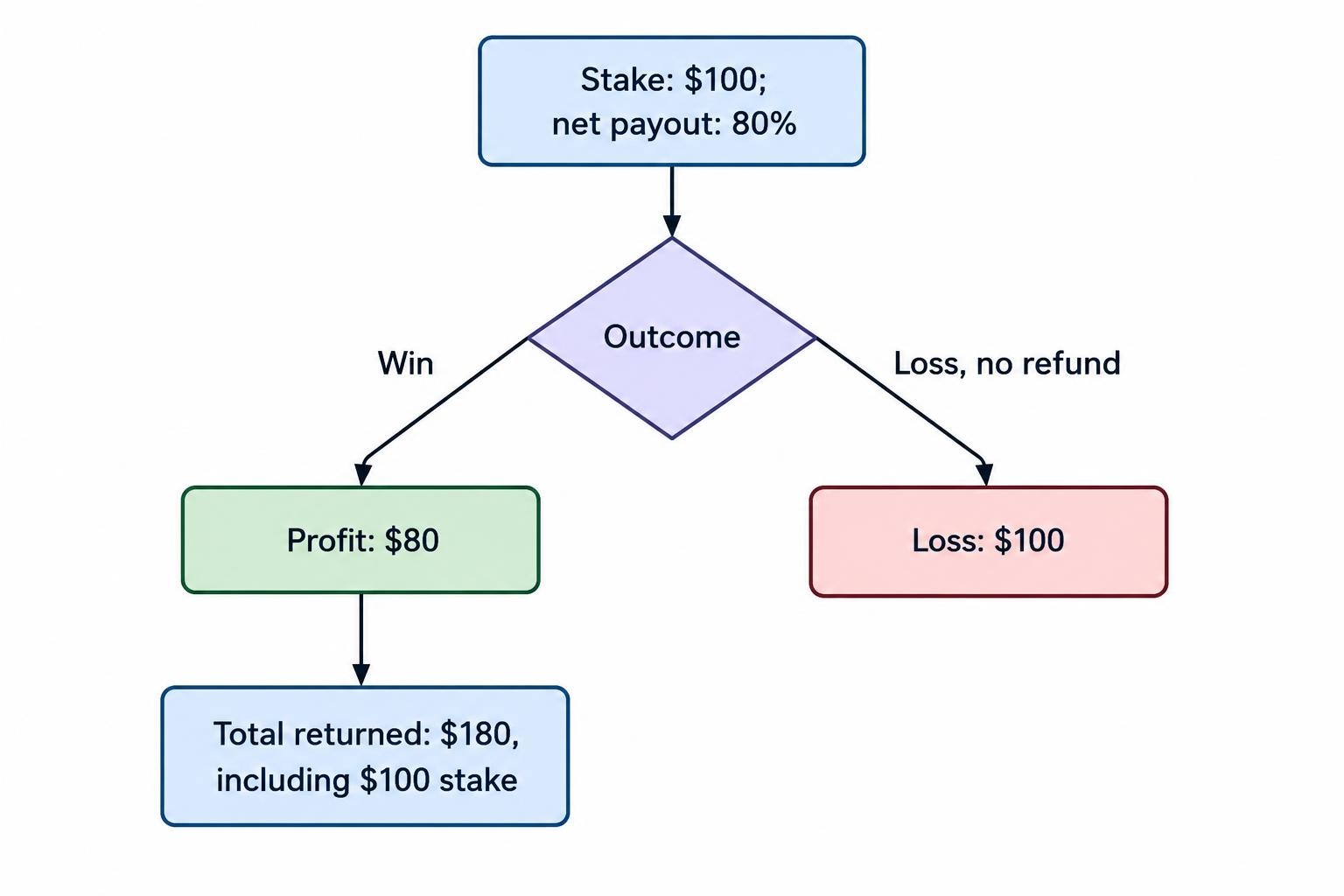
For a hypothetical $100 contract offering an 80% net profit on a win:
- Stake: $100 committed to the contract.
- Winning profit: $80 before any separate charges.
- Total returned after a win: $180, including the $100 stake.
- Losing result: a $100 loss if there is no refund.
The joint CFTC and SEC investor alert on binary options describes the predetermined cash-or-nothing structure and notes that some contract variations return a small portion of the deposit after a loss. The contract terms therefore matter more than the label on the calculator.
If a quoted $180 is the total return on a $100 stake, the profit is $80. Entering 180% into a field expecting the net profit percentage would produce the wrong answer.
How a Binary Options Payout Calculator Works
For the percentage-of-stake model, let S represent the stake and r the net payout rate expressed as a decimal. Enter an 80% rate as 0.80 when calculating manually.
Winning profit = S × r
Total returned after a win = S × (1 + r)
A $75 stake at an 80% net payout produces $60 profit and a $135 total return. Without a refund, an unsuccessful contract loses $75.
These calculations assume settlement at expiry. If a contract permits an earlier sale or closure, calculate that result from the actual closing proceeds, entry cost and charges. Do not apply the expiry payout percentage to a different transaction.
Contracts Quoted by Purchase Price and Settlement Value
A calculator also needs to match the way the contract is priced. Suppose a hypothetical contract costs $40, pays $100 if successful and pays zero otherwise. The winning profit is $60 and the losing amount is $40, before fees.
That is a 150% potential profit relative to the $40 purchase price. It is not a contract offering a 100% net payout simply because its settlement value is $100. Translate the terms into cash profit and cash loss before calculating the break-even rate.
Calculate the Break-Even Win Rate
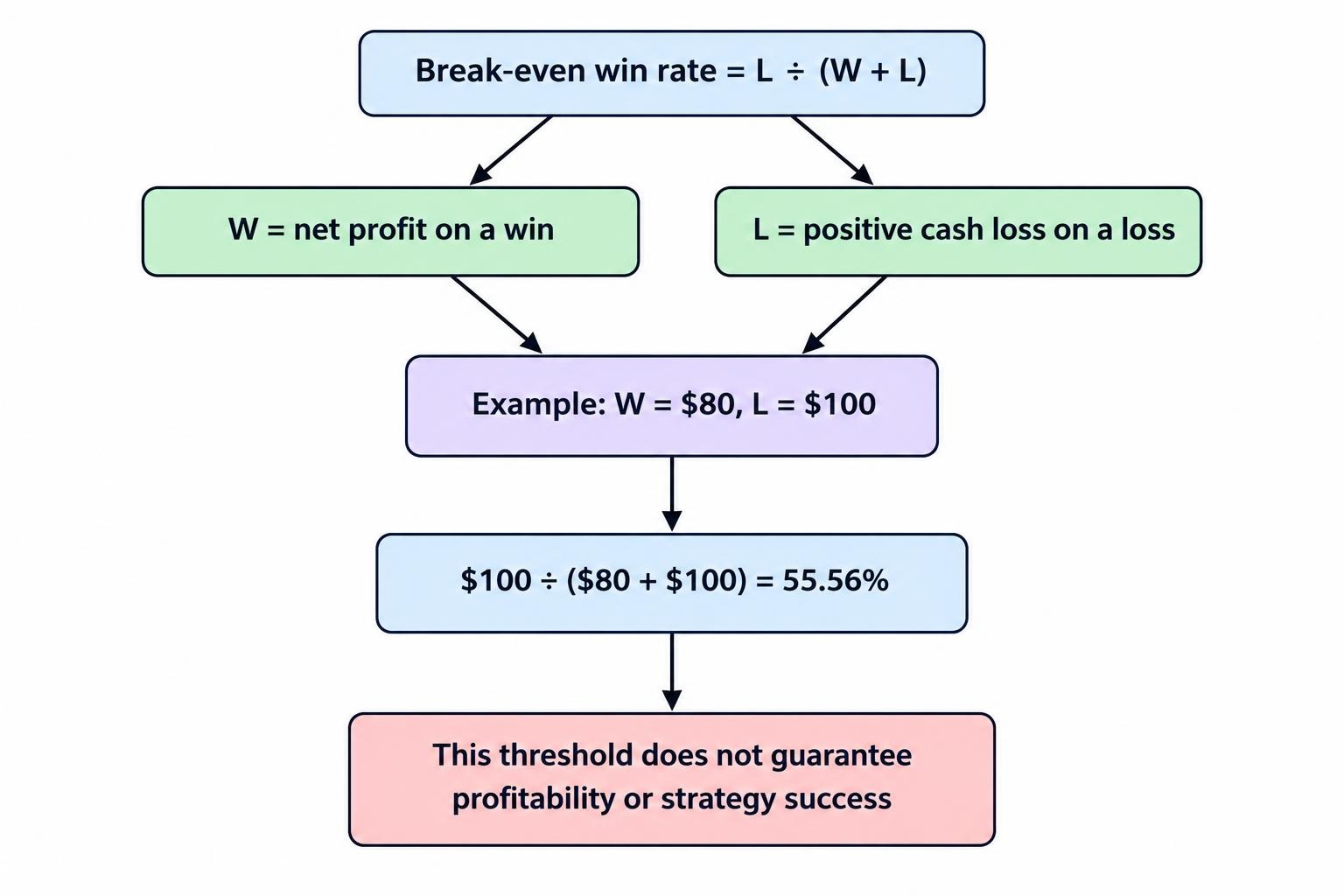
Let W be the net profit from a win and L the positive cash amount lost on a loss. For two possible outcomes:
Break-even win rate = L ÷ (W + L)
Multiply the result by 100 to express it as a percentage. With an $80 profit and a $100 loss, the calculation is $100 ÷ $180 = 55.555…%.
Where the entire stake is lost on an unsuccessful contract and there are no fees, the shorter formula is:
Break-even win rate = 1 ÷ (1 + r)
| Net payout on a win | Profit on a $100 stake | Break-even win rate |
|---|---|---|
| 50% | $50 | 66.67% |
| 60% | $60 | 62.50% |
| 70% | $70 | 58.82% |
| 75% | $75 | 57.14% |
| 80% | $80 | 55.56% |
| 90% | $90 | 52.63% |
| 100% | $100 | 50.00% |
The displayed percentages are rounded. They describe the mathematical threshold, not a promise that a strategy can reach it. A claimed accuracy figure needs separate scrutiny; the guide to evaluating binary options performance claims covers that assessment.
Individual trades also come in whole numbers. Across 100 equal $100 trades at an 80% payout, 55 wins produce a $100 loss. With 56 wins, the result becomes an $80 profit. Neither result lands exactly on the theoretical threshold.
Adjust for Fees, Refunds and Ties
The most reliable approach is to calculate the cash result for each outcome, then use those amounts in the break-even formula. This avoids forcing every contract into a no-fee, full-loss assumption.
Fees Increase the Required Win Rate
Suppose a hypothetical $100 contract pays $80 profit on a win and charges $2 per completed trade, regardless of outcome. The winning profit falls to $78. The losing amount rises to $102.
Break-even win rate = $102 ÷ ($78 + $102) = 56.67%
If charges differ between winning and losing outcomes, adjust each side separately. Avoid subtracting a fee twice when the advertised payout already includes it. Account charges, currency conversion and withdrawal costs should also appear in a separate account-level calculation where applicable; they are not necessarily incurred on every trade.
Loss Refunds Change the Calculation
Now suppose there are no fees, but the contract returns 10% of the stake after an unsuccessful outcome. A $100 stake then has an $80 winning profit and a $90 losing amount.
Break-even win rate = $90 ÷ ($80 + $90) = 52.94%
Use this adjustment only when the refund is part of the contract and genuinely reduces the cash loss. Do not treat a promotional credit requiring further activity as equivalent to money returned without conditions.
Ties Need Their Own Outcome
A calculator should not silently count an unchanged settlement price as either a win or a loss. Check the contract’s treatment of equality. If a tie returns the stake without charges, it contributes zero profit and can be excluded when calculating the win rate among decisive outcomes. A tie that incurs a charge is not financially neutral.
Expected Value Is Different From Potential Profit
A payout calculator tells you what a successful contract could earn. Expected value combines the winning and losing amounts with an assumed probability of success.
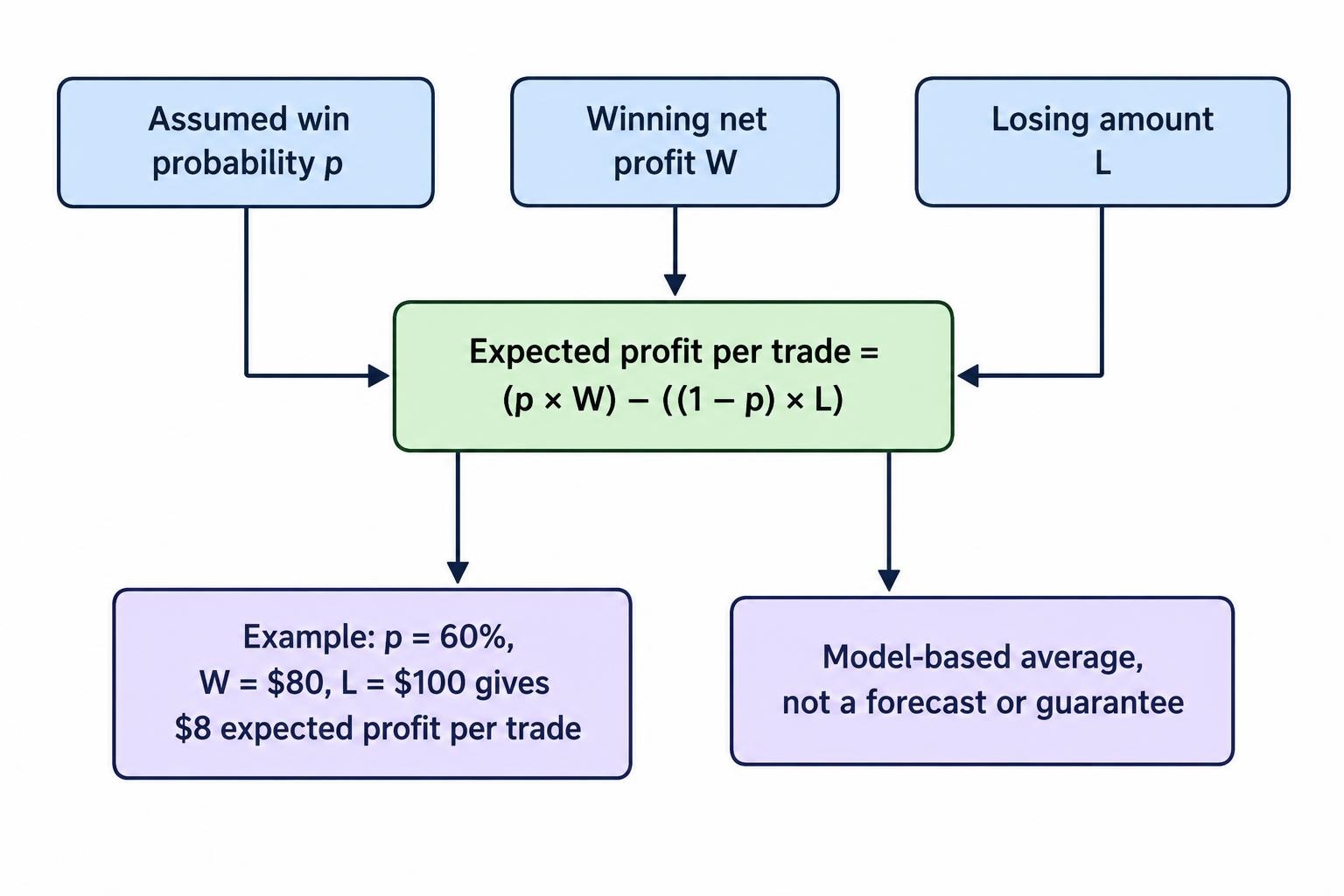
Let p represent the assumed win probability:
Expected profit per trade = (p × W) − ((1 − p) × L)
For a $100 stake, an 80% payout and an assumed 60% win probability, with no fees or refunds:
Expected profit = (0.60 × $80) − (0.40 × $100) = $8
Change the assumed win probability to 55%, and expected profit becomes negative $1 per trade. At 50%, it becomes negative $10. The payout has not changed; only the probability assumption has.
The weak point is usually that assumption. Winning 60 of the last 100 trades gives an observed win rate of 60%, not proof that the next trade has a 60% chance of success. Statistical methods such as the NIST confidence intervals for proportions quantify sampling uncertainty under their model assumptions.
For trading analysis, also ask whether those assumptions are reasonable. Results gathered under one set of entry rules, expiry times and market conditions may not represent another. Extra decimal places do not repair a questionable probability estimate.
Expected value is an average under a model, not a forecast of the next result or a guarantee for a trading session. Even a positive hypothetical value does not remove the possibility of losses.
Use Actual Payouts When Reviewing Trading History
A single payout percentage works for a group of trades only when it accurately represents their terms. If stakes, payouts or charges vary, calculate each trade’s net result and add the results together.
Consider 100 hypothetical trades of $100 each, with 60 wins and 40 losses. At an 80% payout throughout, the profit is $800: $4,800 from winning trades minus $4,000 in losses. At a 60% payout throughout, the same win rate produces a $400 loss.
For mixed payouts, avoid multiplying an aggregate win rate by a simple average of every quoted payout. The payouts attached to the winning trades determine the winning cash receipts. Stake differences can distort a headline accuracy figure too.
Record the stake, agreed payout, result, refund, fees and net profit for each contract. The guide to exporting and analysing binary options trading history covers the records needed for that review.
Keep deposits and withdrawals separate from trading profit. Adding $500 to an account raises its balance, but it does not turn a losing strategy into a profitable one.
What to Check Before Using a Calculator
A useful calculator exposes its assumptions. Look for separate fields or clear settings for the stake, net payout percentage, fees and loss refund. Its output should distinguish winning profit, total returned, losing amount and break-even rate.
Test it with a simple case before trusting more elaborate results. A $100 stake at an 80% net payout, without fees or refunds, should show $80 profit, $180 returned and a 55.56% break-even rate. If it does not, investigate the field definitions rather than assuming the calculation is sophisticated.
Check percentage entry, too. A field labelled “payout percentage” may expect 80, whereas a decimal-rate field expects 0.80. Reject negative stakes, refunds above the stake and other inputs that do not match the stated contract.
A basic arithmetic tool has no need for your payment card, identity documents or trading-account password. Be cautious if a calculator turns into a deposit pitch. The SEC alert on fraudulent binary options websites identifies high-pressure sales tactics and supposedly unbiased rankings paid to promote platforms.
Stake Size Cannot Repair Negative Expected Value
Increasing the stake changes the cash exposure, not the no-fee break-even percentage. At an 80% payout, both a $10 stake and a $1,000 stake require the same 55.56% win rate under otherwise identical terms.
Be especially wary of “recovery” calculations. After losing $10, earning back that loss plus an $8 target profit requires a $22.50 winning stake at an 80% payout. If that trade also loses, recovering the accumulated $32.50 loss plus the same $8 target requires approximately $50.63 on the next trade.
The arithmetic shows how quickly exposure grows. It does not make a winning outcome more likely. Test calculations with hypothetical balances through binary options demo software and simulators, without treating simulated results as evidence that withdrawals or live settlement will work as expected.
Check Legality Separately From the Numbers
A correct formula says nothing about whether an operator may offer a contract to you. U.S. users should verify the operator, venue and product’s regulatory status rather than relying on branding or software availability. An app-store listing does not establish compliance with CFTC regulations, a distinction made in the CFTC warning about binary options mobile apps.
Keep that check outside the calculator workflow. A low break-even threshold cannot compensate for an unlawful offering, unclear settlement terms or an operator that does not return money.
Rules also differ by jurisdiction. In the UK, the retail prohibition took effect on April 2, 2019. The FCA rules on retail binary options prohibit firms within scope from selling, distributing or marketing the covered contracts to retail clients.
Use payout and break-even calculators to expose the economics: what a win earns, what a loss costs and which assumptions must hold. If the inputs are uncertain, the output should prompt more questions—not a larger stake.