Compare binary options platform price feeds by matching the underlying instrument, price type, timestamp and settlement rule—not by checking whether two charts look alike. A small difference can change a contract’s result near its strike price, yet that difference may come from ordinary data handling rather than manipulation.
The useful question is whether you can reproduce the platform’s settlement from its published rules and retained data. Before testing, verify the provider’s identity and regulatory status. US readers can start with the CFTC’s registration and background checks; a convincing chart is not a substitute for those checks.
Identify Which Price You Are Comparing
A binary options screen can display several prices that serve different purposes. The underlying price tracks the asset named in the contract, such as EUR/USD or a stock index. The strike sets the threshold for the outcome. The settlement value determines the result under the contract’s rules.
An exchange traded binary contract may also have its own bid, ask and transaction price. Those are prices for the contract, not quotations for the underlying asset. Comparing a binary contract quoted at 62 with a stock index at 5,200 tells you nothing about feed accuracy.
Build a comparison record before collecting observations:
| Comparison field | What must match | Why it matters |
|---|---|---|
| Instrument | Asset, venue, currency and contract month where relevant | A cash index and its futures contract are different instruments. |
| Price type | Bid, ask, midpoint, last trade or calculated benchmark | Different measurements can produce different outcomes. |
| Timestamp | Time zone, timestamp meaning and precision | Simultaneous screen captures may contain observations from different times. |
| Market session | Regular hours, extended hours or another defined session | Session coverage changes which observations enter the feed. |
| Settlement method | Snapshot, averaging window or another published calculation | The final chart point may not determine settlement. |
| Precision | Stored decimals and rounding rules | A rounded display can hide a difference around the strike. |
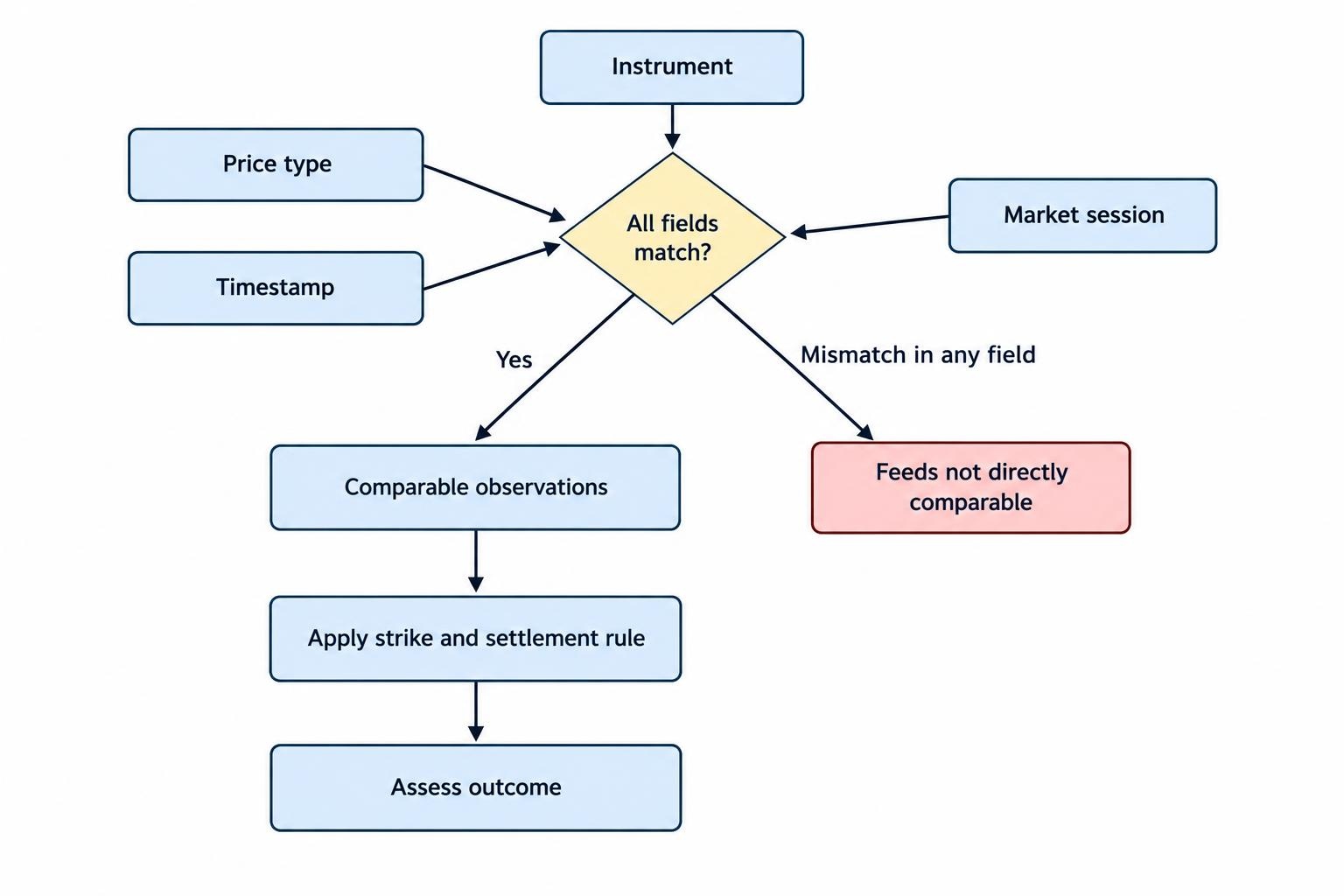
Why Two Legitimate Price Feeds Can Differ
Bid, Ask and Last Trade Are Different Measurements
A last trade records a completed transaction. A bid or ask records a quotation. A midpoint is calculated from the bid and ask. These values need not be identical, even when their timestamps match. The NYSE Best Quote and Trades feed specifications, for example, distinguish bid and offer quotations from trades and closing prices.
Consider a hypothetical EUR/USD observation with a bid of 1.08234 and an ask of 1.08240. Its midpoint is 1.08237. For a contract requiring a value strictly above 1.08236, the bid and midpoint sit on opposite sides of the threshold.
That does not establish that either feed is wrong. It establishes that the comparison needs the contract’s price definition. Same symbol, different measurement.
Venue Coverage and Instrument Selection Matter
For currencies, do not assume every feed observes one central market price. Spot FX trades over the counter across dealers and venues rather than on a single central exchange. The BIS research on FX trade execution documents this fragmented structure.
Use a second FX feed as a cross-check, not automatic proof of the only correct price. Record its contributing venues or providers where disclosed.
Apply the same discipline to other assets. Check whether a stock quotation covers the same trading session. Confirm whether an index symbol represents the cash index, a futures contract or a derived product. For cryptocurrency, identify the exchange or benchmark rather than treating every dollar quotation as interchangeable.
Two platforms agreeing also provides less reassurance if both redistribute the same upstream feed. Independent branding does not necessarily mean independent evidence.
Read the Expiry Rule Before Checking the Chart
The contract specification should identify the reference source, observation time and calculation used for settlement. Ask whether the result uses the last eligible observation before expiry, the first observation afterward, an average over a window, or another method. These are different tests.
Check the exact comparison too. “Above” and “at or above” produce different results when settlement equals the strike. Establish how equality, missing data, market interruptions and later corrections are handled. Do not assume every platform refunds a tie.
Benchmark names deserve particular care. The CME CF Bitcoin Real Time Index and Bitcoin Reference Rate both concern bitcoin’s dollar price, but one is a continuously published index and the other a daily rate calculated from a defined window. Their distinction is set out in the CME explanation of bitcoin pricing benchmarks. A contract referencing one cannot be checked simply by substituting the other.
Save the specification that applied when the contract was entered, including its version or effective date where available. A support message saying “we use market prices” leaves too much unanswered.
Also distinguish the displayed countdown from the contractual expiry timestamp. A browser animation is not a sufficiently precise record for reconstructing settlement.
Run a Controlled Price Feed Comparison
Use observation or a demonstration account where available rather than depositing money just to test quotations. A demo can help you inspect timestamps, exports and chart behavior, but it does not establish that live accounts use identical processing. Keep that distinction clear when using binary options demo software and simulators.
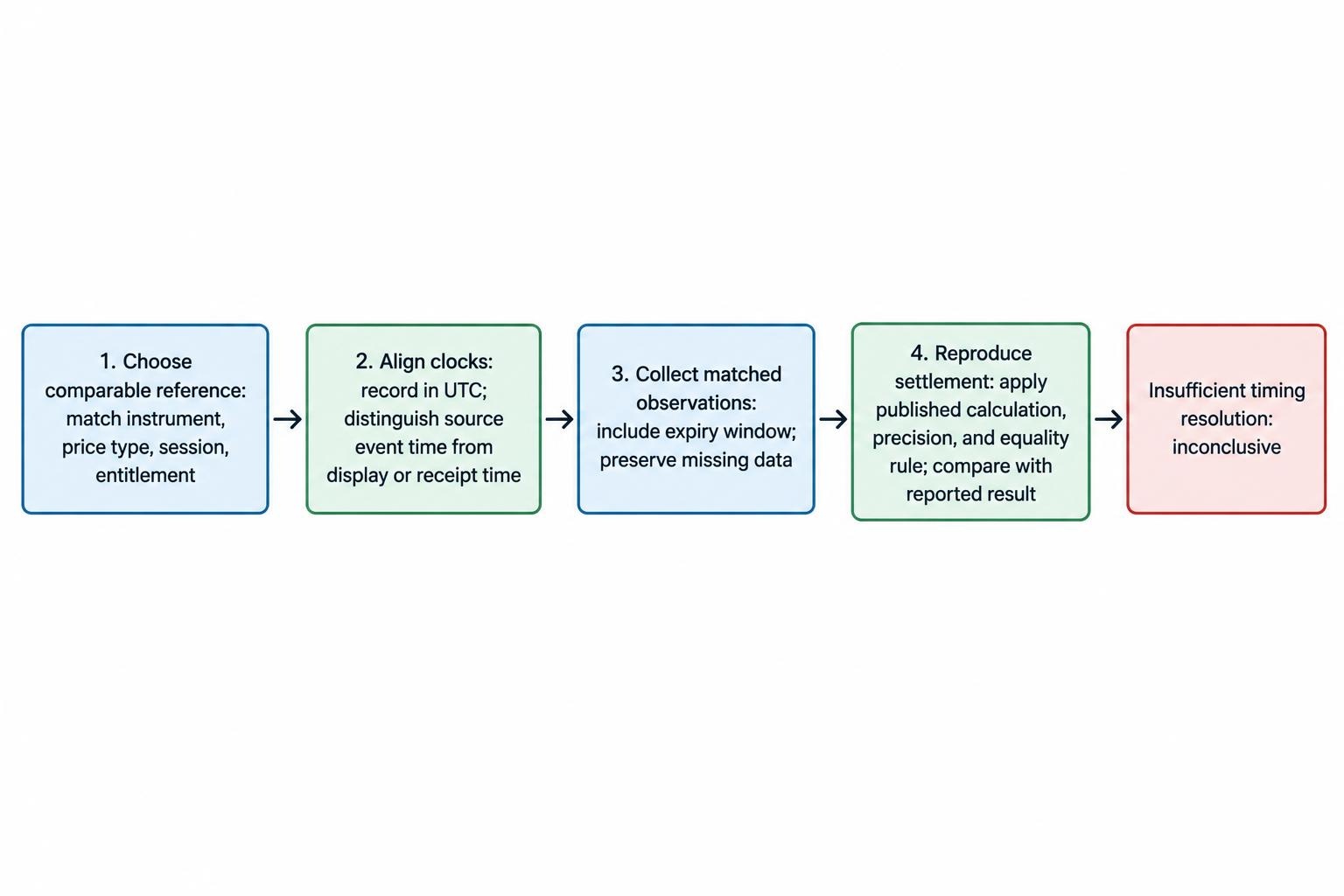
A practical comparison has four stages:
- Choose a comparable reference. Match the instrument, price type, session and data entitlement. Check whether the reference is live or delayed. Prefer the named settlement source when access is available.
- Align the clocks. Use UTC for your records and check the recording device’s clock. Separate the source’s event timestamp from the time your device received or displayed the observation.
- Collect matched observations. Record the platform value and reference value over predetermined periods, including ordinary trading and the expiry window. Preserve missing observations rather than filling them with invented values.
- Reproduce the settlement. Apply the published calculation, precision and equality rule to the eligible observations. Compare that result with the platform’s reported settlement.
Choose observation windows before seeing the outcome. A comparison assembled entirely from disputed losses cannot show how frequently mismatches occur across all observations. Include contracts or periods with no dispute, and retain results that contradict your initial suspicion.
Collect data at a frequency suited to the rule being tested. One observation per second cannot reconstruct every event within that second. If expiry depends on finer timing than your records capture, mark the result inconclusive rather than assigning a winner from incomplete evidence.
Screen recordings help document what appeared on screen. They do not, by themselves, measure end to end feed latency: the recording includes browser rendering, network delivery and capture timing. Where permitted and available, timestamped exports provide a stronger basis for comparison.
Measure Differences Without Creating False Precision
A useful spreadsheet separates price disagreement from timing uncertainty. Record the platform value, reference value, their respective timestamps and the price type. Add the strike and settlement window when examining a contract outcome.
Calculate the signed difference as the platform value minus the reference value. Its typical direction can reveal a persistent offset worth investigating. Calculate the absolute difference to measure gap size without positive and negative differences cancelling each other.
Also record the largest observed gap and the proportion of matched observations that fall on opposite sides of the strike. The latter is especially relevant to binary contracts: two feeds can look almost identical while disagreeing at the threshold that determines payment.
Keep the original records alongside the calculations. A documented process for exporting and analysing binary options trading history makes it easier to connect a disputed observation with its contract identifier, entry record and reported settlement.
Measure apparent staleness cautiously. An unchanged last trade may mean no new transaction occurred; an unchanged quote may reflect a genuinely unchanged market. Missing updates, repeated timestamps and a frozen display are different observations and should not share one label.
There is no useful universal tolerance such as “a difference below one pip is acceptable.” The relevant question is whether the difference fits the disclosed feed construction and whether the contract settled under its published rules. State the sample size, missing data and timestamp resolution beside any summary figure.
Treat Weekend and Synthetic Prices Separately
If a platform offers a weekend or synthetic instrument, establish what generates its prices before comparing it with a familiar market chart. Ask whether it tracks an external market, follows a published calculation or uses an internally generated series.
The label “OTC” does not answer that question. Ordinary spot FX is itself an over the counter market; that does not make every OTC product equivalent to an independently observable currency quotation.
If the product follows its own series, a weekday market close cannot validate its later movements. Request the calculation method, historical observations, settlement rules and correction policy. If these are unavailable, describe the feed as independently unverifiable rather than claiming that a loosely similar external chart proves it accurate.
Separate Unexplained Gaps From Evidence of Manipulation
A different candle shape is not proof of fraud. Neither is one screenshot showing a losing settlement beside a winning reference chart. First eliminate mismatched instruments, bid versus midpoint comparisons, delayed data, rounding and different observation times.
Software manipulation is nevertheless a documented concern. Complaints described in the joint CFTC and SEC binary options fraud alert include distorted prices and payouts, and allegations that expiry countdowns were extended until winning trades became losses.
Escalate a discrepancy when the platform’s result cannot be reproduced from its own disclosed rules, or when its explanation conflicts with retained records. Ask for the exact settlement observations, timestamps, source identifier and calculation—not another picture of the same chart.
Preserve the contract identifier, terms, relevant exports, original recordings and correspondence. Keep originals unchanged and use copies for annotations. A concise evidence packet is more useful than a long complaint built around the statement that the chart “looked wrong.”
Decide Whether the Feed Is Verifiable
A stronger platform comparison favors disclosed sources, clear settlement rules, usable timestamps and records that let you reconstruct an outcome. Smooth animation and extra decimal places should carry little weight if the underlying observations cannot be checked.
Keep feed quality separate from profitability. Reproducing a settlement does not demonstrate that a strategy has positive expected returns, or that promotional results are representative. Those questions need a separate assessment of binary options software performance claims.
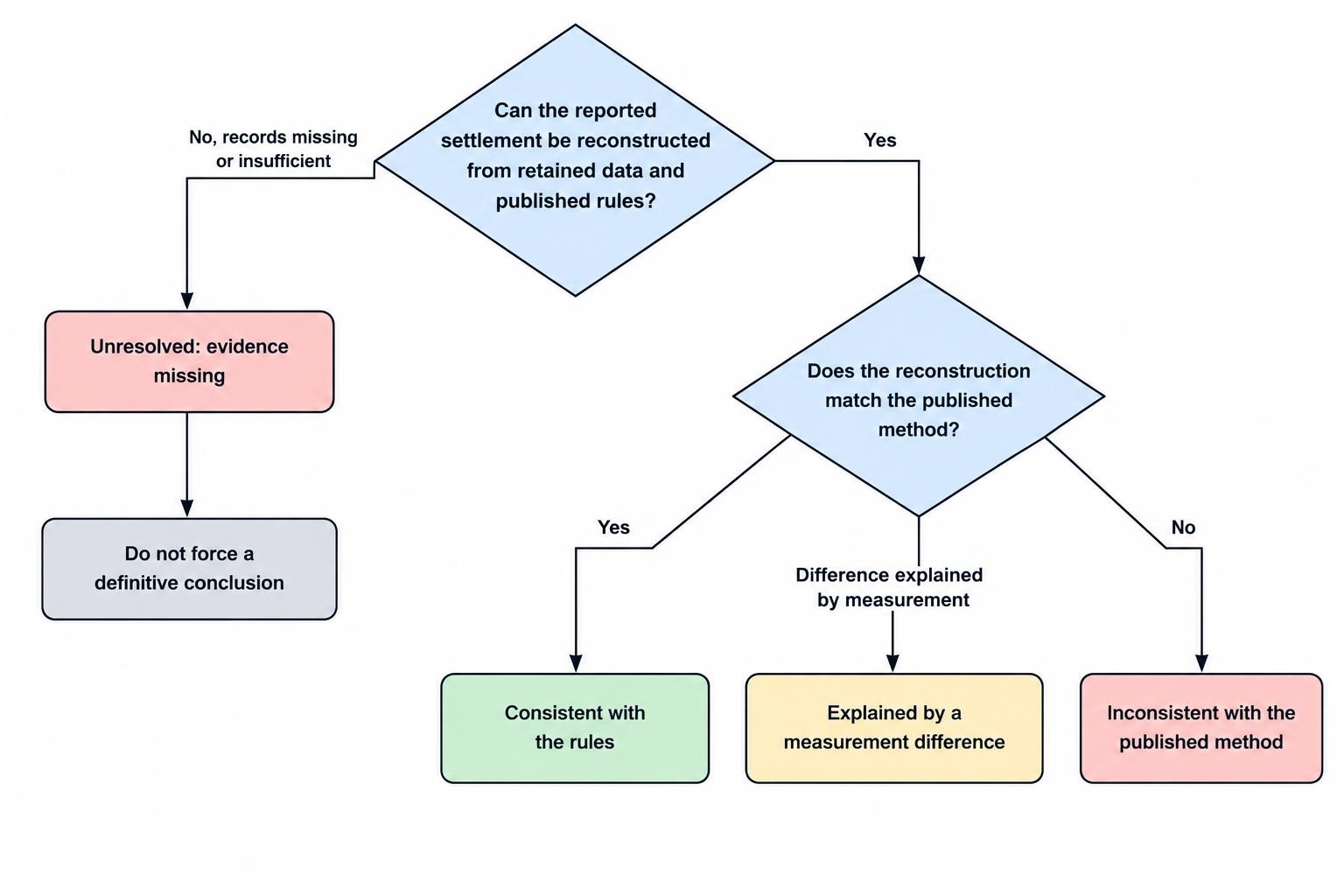
Classify your finding honestly: consistent with the rules, explained by a measurement difference, unresolved because evidence is missing, or inconsistent with the published method. “Inconclusive” is a valid result. It is better than inventing precision your records cannot support.
Price verification also leaves other risks untouched, including withdrawal problems and operator misconduct. Review the broader binary options risk warning before treating a successful feed check as permission to fund an account. The objective is a reproducible comparison, not a chart that offers reassurance.