Broker APIs for automated trade execution connect trading software to a brokerage account so it can submit orders, receive execution reports and check account activity without manual order entry. The difficult part is not sending the first order. It is keeping the software’s records aligned with the broker when orders fill in pieces, requests time out or connections fail.
Within an automated trading software system, the execution connection deserves its own design and testing process. A strategy decides what it wants to trade. The execution layer must translate that decision into valid instructions, control exposure and establish what actually happened.
What an Execution API Must Support
Start with the complete trading workflow rather than a successful order submission example. Your software needs to identify the correct account and instrument, check permissions, submit an order and follow its progress. It also needs a way to retrieve open orders, recent executions and positions after a restart.
Separate three functions in the design: market data, order entry and account reporting. Confirm which interfaces provide each function and whether their subscriptions, permissions and operating hours match your intended use. Receiving a price does not establish that the account can trade that instrument.
| Interface | Role in an execution system | What to check |
|---|---|---|
| REST API | Request and response operations such as submitting orders or retrieving positions | Authentication, request limits, order lookup and response meanings |
| Streaming connection | Receiving order events and other updates without repeatedly requesting them | Reconnect behavior, replay support, sequencing and missed event recovery |
| FIX connection | Structured trading messages with defined order and execution fields | Supported message versions, session requirements and the broker’s implementation rules |
| SDK or local gateway | A software library or application through which your system communicates | Supported versions, login requirements, dependencies and restart procedures |
Do not treat the interface label as a performance ranking. Build a shortlist around the operations your strategy needs, then assess how much software you must maintain. A convenient SDK is useful only if its behavior, supported functions and failure reporting meet those requirements.
Choose Around Trading Requirements, Not Language Preference
Write down the intended account type, asset classes, order frequency and trading sessions before comparing APIs. Include whether the strategy needs short selling, fractional quantities, linked exit orders or trading outside regular hours. Verify availability for the account you will actually use, not just the broker’s demonstration environment.
Instrument identification deserves particular care. Store the broker’s instrument identifier alongside the symbol, exchange, currency and contract details where relevant. For derivatives, include expiry and contract multiplier. Make quantity units explicit: shares, contracts, currency units and cash amounts are not interchangeable.
Check price increments, minimum quantities and rounding rules before submission. Use decimal representations appropriate to the API rather than allowing rounding to change an order’s price or size. Also establish whether order changes amend an existing order or require cancellation and replacement. That distinction affects how your software tracks working quantities.
Follow the Order Lifecycle
An execution system needs more states than “sent” and “done.” Distinguish a request awaiting a response from an accepted order, a partial fill, a completed fill and a rejected instruction. Treat pending cancellation as an unfinished operation. The FIX order state specification separates these states and explicitly distinguishes a pending cancellation from a confirmed cancellation.
Persist the intended order before transmitting it. Record the strategy decision, account, instrument, side, quantity, price instructions and a local identifier. When the broker responds, associate its order identifier with that record. Keep execution identifiers separately so the same fill cannot be counted twice when events are replayed.
Design the strategy to react to confirmed executions rather than assuming that submitted quantities became positions. Keep filled quantity, remaining working quantity and average execution price as separate fields. A final order status should not erase the history that explains how the position was created.
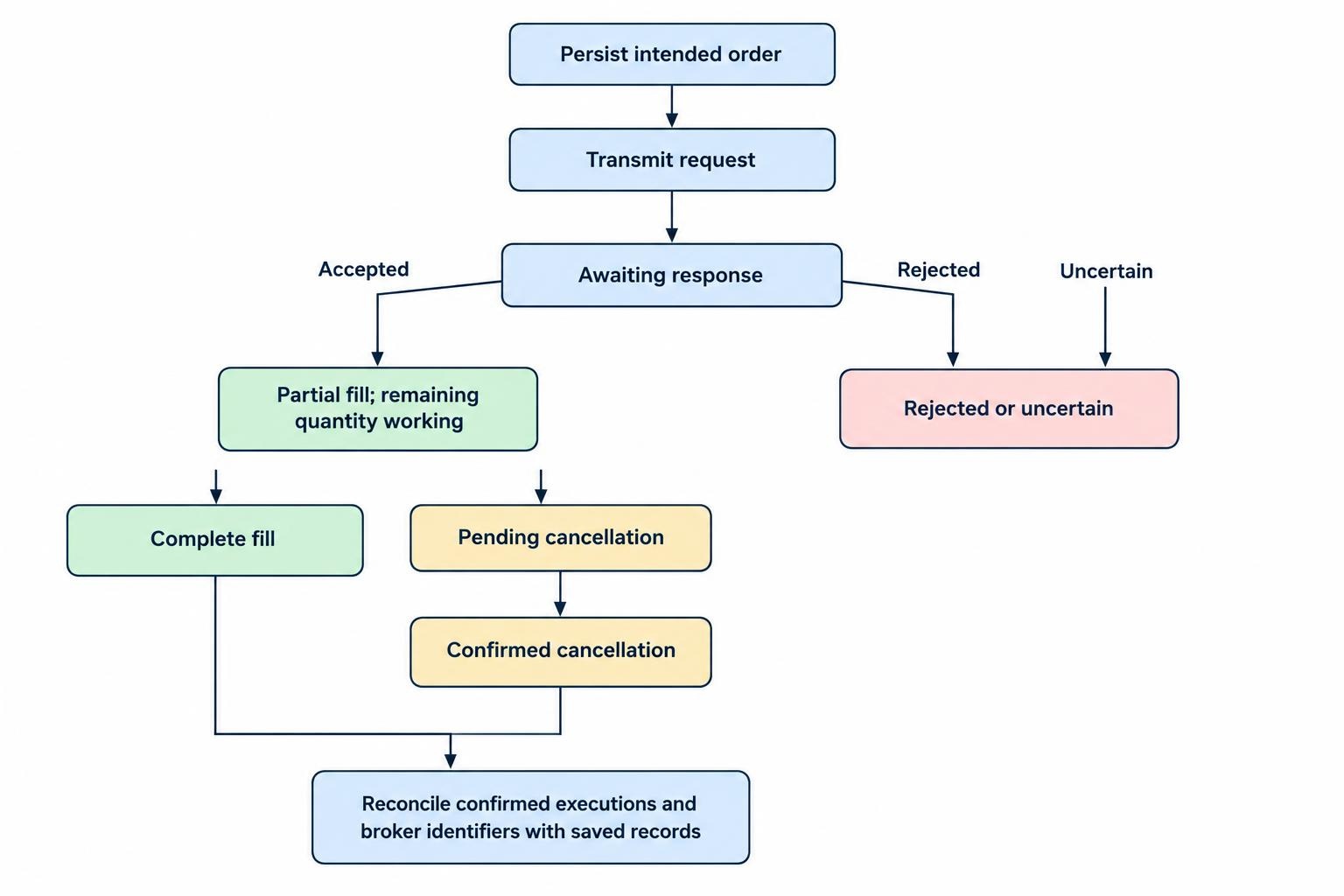
At startup, retrieve current account information and compare it with the saved records before allowing new exposure. Include manual trades and orders submitted by other applications. If several strategies share an account, assign ownership to their orders while still checking risk across the entire account.
Translate Strategy Intent Into Order Instructions
Choose order instructions deliberately. For stock trades, a market order does not guarantee an execution price, while a limit order sets a price boundary but does not guarantee execution. Stop prices are triggers rather than guaranteed fill prices. These distinctions are covered in the SEC investor bulletin on order types.
Make time in force and session eligibility explicit where the API permits. Do not let an undocumented default decide whether an order can remain active overnight or participate outside regular hours. Confirm the trigger method and hosting location of conditional orders too: does the broker hold the instruction, or must your application remain connected to activate it?
For linked entry and exit orders, establish what happens after a partial entry fill. Ask when protective orders become active, how their quantities change and whether cancellation of one linked order is confirmed before another action proceeds. Names such as “bracket” are not a substitute for documented behavior.
Keep Positions and Working Orders Separate
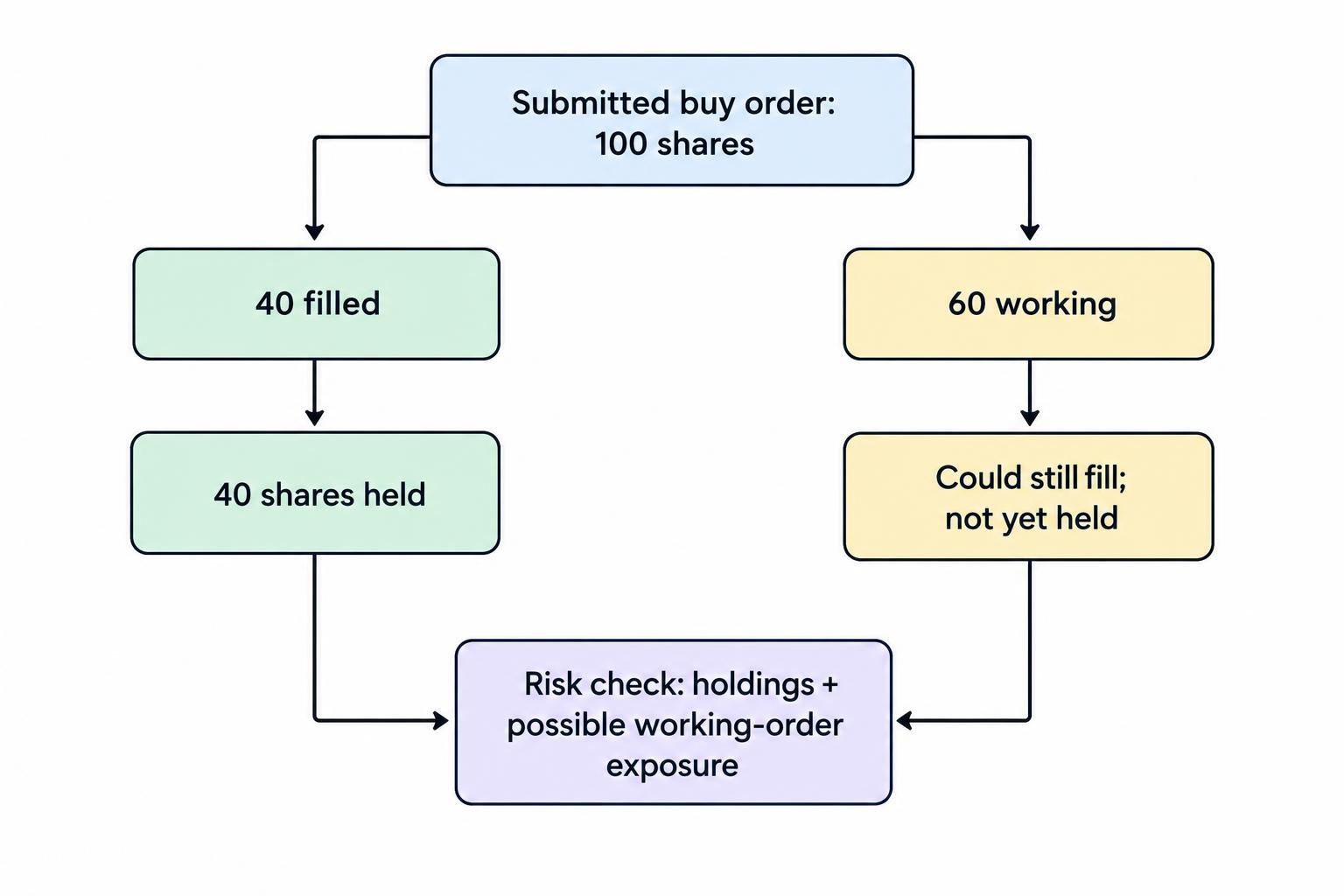
Consider a hypothetical order to buy 100 shares. Forty shares fill and 60 remain working. The account holds 40 shares, but the order can still add another 60. Your risk checks should account for both the current holding and the possible exposure from the remaining order.
If the strategy now wants only 50 shares in total, submitting another purchase is the wrong starting point. First reconcile the 40 shares already acquired and the 60 still working, then determine the permitted adjustment. The execution layer should turn a target position into an order decision, not blindly translate every signal into another trade.
Reserve capacity for working orders when checking strategy and account limits. Use an exposure measure appropriate to the product, including contract multipliers and currency conversion where needed. Keep these controls outside the signal calculation so a strategy cannot bypass them through repeated requests.
Handle Uncertain Responses Without Guessing
A missing response is an uncertain outcome, not proof that an order failed. Before resubmitting, look for the original instruction using the broker’s supported lookup methods. Check open orders and executions as necessary. The detailed recovery process belongs in handling failed orders, retries and duplicate trades; the architectural requirement is to preserve enough identifiers and records to investigate.
Where an API offers idempotency protection, confirm its scope, retention period and behavior when a request changes. A client order identifier does not automatically establish that repeated submissions are safe. Build against documented guarantees rather than assumptions about what an identifier ought to do.
Plan request capacity before launch. Check whether limits apply per account, credential, connection or operation, and whether cancellation requests share capacity with routine queries. Set your own traffic controls so repeated position polling or reconnect attempts cannot consume all available request capacity.
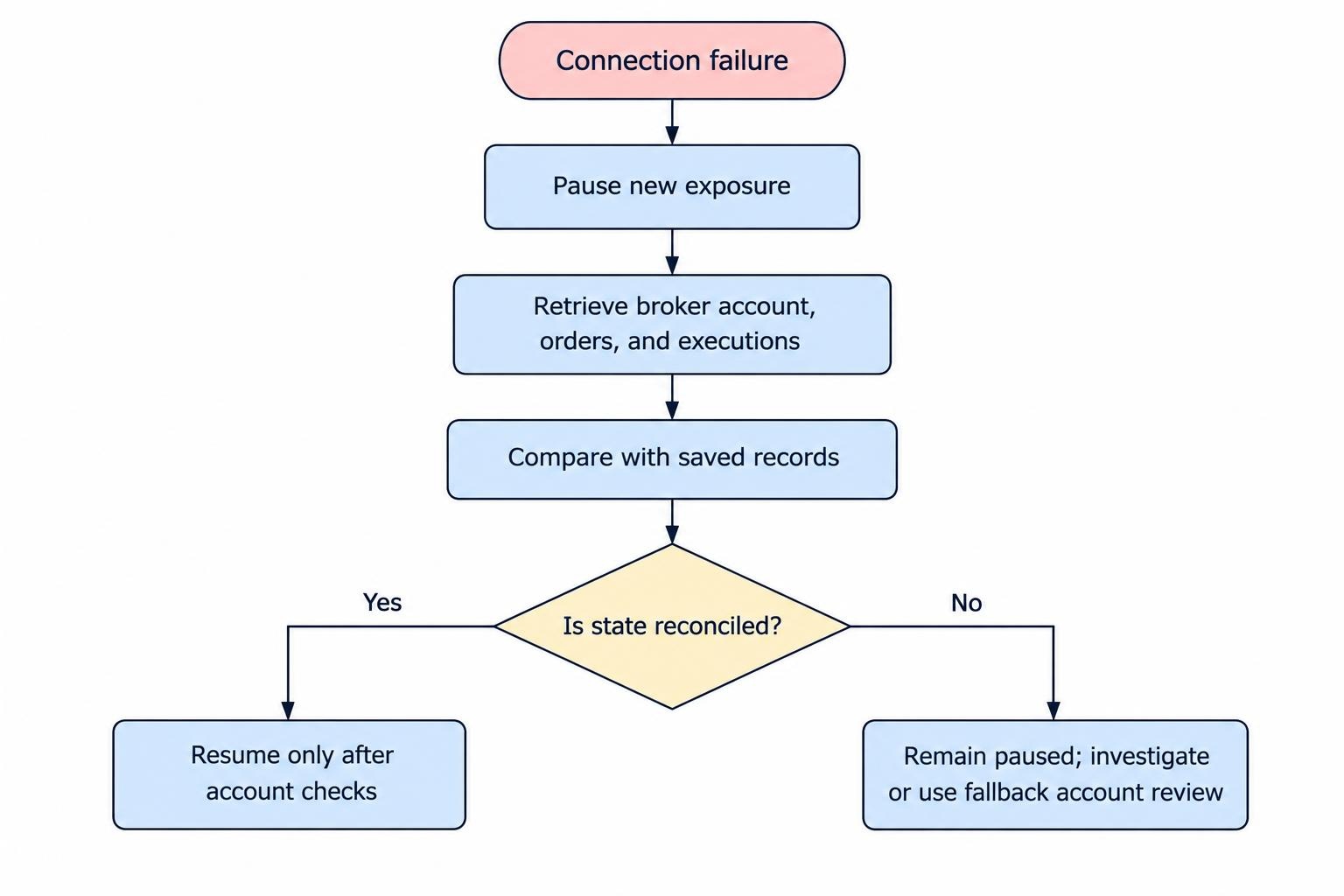
Keep recovery work separate from ordinary strategy activity. During a connection incident, pause new exposure while the application establishes order and position state. Avoid allowing a backlog of old signals to become a burst of new orders after reconnection.
Define What Happens When the Connection Drops
Do not assume that disconnecting cancels working orders. Cancellation behavior depends on the connection and its configuration. For example, CME’s documented Cancel on Disconnect setup excludes Good Till Canceled and Good Till Date orders, and its configuration is available to clearing firm administrators.
Write down the required behavior for each failure: lost market data, lost order updates, expired authentication, broker unavailability and application restart. Distinguish “stop submitting new orders” from “cancel working orders” and “close positions.” These are separate actions, not interchangeable emergency buttons.
Establish a fallback route for reviewing the account when the automated connection is unavailable. Document who can use it and how manual actions will be reconciled afterward. Restarting the application should begin with account checks, not an immediate return to trading.
Protect Credentials and Trading Permissions
Store API credentials outside source code, shared notebooks and ordinary logs. Restrict access to the processes and people that need it, and maintain a revocation procedure. These practices follow the access control and credential lifecycle principles in the OWASP secrets management guidance.
Where the broker supports permission scopes, grant only those required for the task. A reporting process should not need order submission rights. Disable withdrawal or transfer permissions for trading software where those controls are available. Keep test and live credentials separate, and make the selected environment unmistakable in configuration and operational displays.
Test credential rotation and token expiry before production. Decide how the application should behave if authentication expires with orders still working. Removing access is not the same as canceling orders, so the incident procedure must address both credentials and account activity.
Test the Connection Before Committing Capital
Use a staged process to validate the integration. Start with account retrieval and order validation, then exercise submissions, amendments, cancellations and reconciliation in a test environment. A structured paper trading process for automated strategies helps separate execution plumbing problems from changes to the strategy itself.
Include interrupted connections, application restarts, partial fills and events delivered more than once in your test plan. Verify that saved records survive a crash and that restarting does not generate another copy of an existing instruction. Where the broker’s simulator cannot reproduce a condition, test your own application’s response using controlled inputs.
Treat simulated results as evidence about the tested workflow, not proof of future execution quality. Identify what the test environment models and what it does not. Keep strategy changes separate from connection changes so a failed test has a traceable cause.
Document test results and use a controlled release process. FINRA’s algorithmic trading control guidance, directed at member firms, covers segregated testing, change management, small pilot deployments and monitoring after release. Those practices provide a useful engineering framework without implying that every retail API user has the same regulatory obligations.
Assess the Operating Cost and Launch Conditions
Evaluate more than commissions. Request the applicable charges and conditions for API access, market data, hosting, connectivity and support. Check whether your intended deployment needs a continuously running gateway, periodic interactive login or additional data permissions. Include maintenance time in the comparison, especially if third party libraries sit between your software and the broker.
Before enabling live execution, require clear answers to four questions:
- Can every submitted instruction be traced to its strategy decision and broker record?
- Can the application reconcile positions, executions and working orders after a restart?
- Will uncertain account state block new exposure rather than trigger a guess?
- Can an authorized operator stop submissions and review the account independently?
Begin any live pilot with a deliberately small exposure cap and predefined review criteria. Track acknowledgement times, rejections, reconciliation differences and execution prices against a stated benchmark. Use trading bot monitoring and emergency stop controls for ongoing oversight rather than treating a successful launch as the end of the work.
The right broker API is one whose behavior you can verify, whose constraints fit the strategy and whose failures your software can handle safely. A connection that sends orders is a starting point. A dependable execution system can also explain every order, recover its state and stop when the evidence is incomplete.